Fireproof Document Bag vs. Fire-Rated Safe: What Protection Are You Actually Buying?
A document bag advertised with an impressive temperature figure is not automatically equivalent to a fire-rated safe. The material might resist a particular exposure while heat still reaches the papers inside. A rating for a complete container asks a different question: what conditions does it keep inside, for how long and under which test?
For protecting records left at home during a fire, prioritize a suitable independently classified container with a documented duration and intended contents. A fire-resistant bag can help organize documents and may offer limited additional protection, but should not replace that specification. Neither product is a reason to delay escape. This guide compares their roles rather than promising that any container survives every fire.
The practical difference
| Question | Fire-resistant document bag | Appropriately fire-rated chest or safe |
|---|---|---|
| What evidence matters? | Complete-bag testing, closure and stated limitations | Exact classification, duration, contents and installation requirements |
| Everyday role | Organization and portable storage within its documented limits | Defined protection for records kept in the closed container |
| Portability | Usually easier to carry | Weight and size may make carrying impractical |
| Water protection | Must be established separately | Also requires its own specification |
| Theft resistance | Generally not an appropriate primary burglary barrier | Fire classification alone does not establish burglary resistance |
| Best fallback if the container is lost | Independent protected copies and recovery records | The same independent backup plan |
Compare the actual products, not just these categories. A cheap metal cash box may have no useful fire rating, while a manufacturer openly describing a bag’s limitations can be more informative than a seller making an unlimited fireproof claim.
Material temperature is not document-survival temperature
A fabric’s ability to resist ignition or remain physically present is different from its ability to keep contents cool. Heat transfer, seams, closure and the complete assembly affect what happens inside. A test on a small sample does not necessarily describe a filled bag.
Ask what was tested: the outer material, a closed empty container or an assembly with a defined internal-temperature limit. Ask for the test method, duration and product identification. If the seller provides only a large temperature number without those details, you cannot turn it into a reliable protection time for your documents.
Do not perform a household fire experiment to resolve the uncertainty. An improvised flame test can be dangerous and does not reproduce a standardized exposure or establish the result in a structural fire.
What a record-protection fire standard assesses
The published scope of UL 72 describes tests for record-protection equipment over specified fire exposures, including limits inside the container. Different classifications relate to different kinds of records. The standard also explains that its fire tests are not a burglary-resistance assessment and do not establish whether equipment remains suitable after fire exposure.
For a buyer, the useful distinction is between a named complete-container classification and a vague claim that a component endured heat. Obtain the exact label and documentation for the model being sold. Do not infer approval from an unrelated product carrying the same brand.
A test rating is still not a prediction that every household fire will match the tested conditions. The building, contents, exposure and location affect a real event. Choose appropriate evidence while retaining an independent recovery plan.
A bag example with clearly stated limits
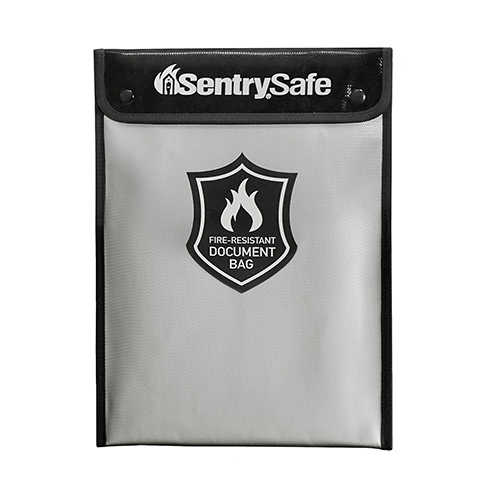
SentrySafe’s FBWLZ0 page describes brief-exposure protection and expressly warns that a document bag will not survive a significant structure fire. It also distinguishes water resistance from waterproofing. The bag is therefore an organizational or supplementary item, not an interchangeable substitute for a rated chest.
The manufacturer suggests using it with a suitable UL-classified fire safe. That suggestion does not establish a new combined certification or allow the individual ratings to be added together. Check that the bag fits without obstructing the safe’s closure.
I would consider this kind of product for keeping selected records together, with its limits understood. I would not buy it on the assumption that the word fire-resistant makes every paper inside safe wherever the bag is left.
A rated-chest example: SentrySafe CHW30220
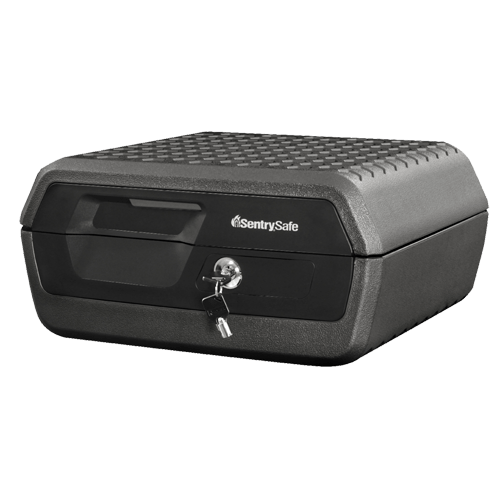
The manufacturer’s CHW30220 technical record specifies a half-hour fire exposure up to 1550°F (843°C), water protection up to 72 hours and a privacy lock not intended for tool attacks. That combination addresses particular hazards; it is not a universal security rating.
Its product page contains inconsistent summary wording about fire duration. The technical record and specification section state half an hour, so that is the duration used here—not the longer claim in the overview. Confirm the label and current documentation on the supplied item before relying on a purchase specification.
This example shows why reading the technical details is more useful than choosing the most impressive sentence on a listing. The pictured chest is not presented as a guarantee that it suits every record type or every storage location.
Paper, photographs and digital media need different checks
Do not assume a container suitable for paper records automatically protects every hard drive, film, electronic device or other temperature-sensitive item equally. Ask for the intended contents and applicable classification, not only the external furnace temperature.
A manufacturer may make additional digital-media claims for a particular model. Read their scope and do not generalize them to another safe with a similar shape. For irreplaceable files, maintain a separate backup rather than relying on one physical device in the container.
Our laptop and data-protection guide explains why a backup in the same bag or location can share the same failure. The same principle applies to a USB drive containing the only scans of the papers beside it.
Water resistance deserves its own specification
Sprinklers, firefighting water and flooding expose containers differently. A fabric coating that sheds splashes does not prove sealed submersion protection. A chest marketed for fire may or may not have a separate verified water specification.
Check the exact conditions, duration and required closure. Inspect seals and latches through the manufacturer’s maintenance routine. Do not assume a damaged gasket still provides the original performance because the lid can be shut.
Placement also matters. Avoid treating the lowest shelf in a flood-prone room as automatically sensible because the product has a water-related label. Evaluate the property and required access while following the maker’s storage instructions.
Fire protection and burglary protection are separate
A portable chest can be carried away. A small keyed latch may provide privacy without meaningful resistance to tools. Conversely, a substantial burglary safe may not include the fire protection needed for documents.
Specify both hazards where both matter. Ask about independent burglary ratings, permitted anchoring and the actual fire classification. Do not drill improvised anchor holes through an insulated container; modifications can affect its intended protection and warranty.
Our home-safe buying guide compares fire, water and burglary requirements as separate decisions. This article concentrates on the narrower question of a bag versus a rated document-storage container.
Check usable interior space
Measure the documents, folders and envelopes you actually intend to store. Exterior dimensions can be misleading because insulation takes up space. A container advertised as spacious may not accept a particular folder flat.
Leave room for the closure and organizer rather than packing against the lid. A bag inside a chest must fit without interfering with seals or the intended latch. More layers are not beneficial if the container no longer closes correctly.
Test with ordinary clean paper and the proposed folders before committing valuable originals. Check whether the person responsible can lift or access the container safely and whether its position remains practical for routine use.
Choose the records before choosing the container
Separate original documents that are difficult to replace from ordinary records available through a provider account. Keep a private inventory showing what is stored, how copies are protected and whom to contact if an original is lost.
Identity, insurance, property and essential medical or financial records may belong in the plan, but retention and original-document requirements vary. Obtain relevant professional advice for legal originals rather than assuming a scan always has the same status.
Do not turn the container into an unorganized archive of expired paperwork and unnecessary identifiers. Our identity-protection guide explains why preserving useful records and reducing redundant sensitive copies can work together.
Keep a genuinely independent backup
A protected digital copy can help with recovery if the physical original is damaged, where a copy is useful for that document’s purpose. Secure the account and confirm you can access it without the phone or laptop that might be lost in the same event.
Another appropriate physical location can also reduce shared exposure. Consider confidentiality, access and the rules governing originals. A second copy in the next drawer does not create much independence from a whole-room fire or flood.
Test retrieval of representative records during normal conditions. You should not discover after an incident that the only recovery code was written on paper inside the damaged container.
Portability is useful during planned departure, not a reason to delay escape
A document organizer can simplify preparation for a forecast hazard or an organized evacuation while it is safe to collect belongings. That is different from stopping to search for paperwork when a fire is developing.
The US Fire Administration’s escape guidance emphasizes getting out promptly and keeping routes usable. Do not return inside for a bag, chest or electronic device. Make the record-recovery plan in advance so personal safety does not depend on carrying the only copy out.
For a household with mobility needs, a heavy chest should not be part of an emergency carrying expectation. Store records appropriately, maintain backups and focus evacuation planning on the people.
Can you put a bag inside a safe?
That may be a supported arrangement for some products, including the manufacturer’s suggestion for the FBWLZ0 example. Check fit, contents and the safe’s instructions. Do not assume a bag plus a thirty-minute chest produces a longer certified duration by simple addition.
The combination can provide organization and another physical layer without establishing a newly tested system. A rating applies to the documented assembly and conditions. Describe the benefit honestly instead of assigning an invented protection time.
Keep access manageable. Several nested containers with keys stored elsewhere can make ordinary document retrieval inconvenient, leading people to leave the outer lid unlatched. A useful arrangement remains correctly closed in daily life.
Storage conditions and moisture
Follow the manufacturer’s instructions about ventilation, approved desiccants and suitable contents. Insulated containers can have particular storage and maintenance requirements. Do not add loose chemicals or a heat source in an attempt to keep papers dry.
Inspect records periodically for moisture or damage while the product is in normal use. If a persistent problem appears, contact the manufacturer and assess the storage location rather than continuing to put more sensitive originals inside.
Keep the container away from activities or equipment that make access unsafe. A safety-storage purchase should not create a blocked exit or a heavy object precariously supported above a bed or work surface.
Compare costs by the job being bought
A low-cost bag and a heavy rated safe are not interchangeable offers at different prices. One may provide organization and limited resistance; the other may provide a specified fire performance, with separate installation and burglary decisions.
| Budget item | Question |
|---|---|
| Container | What independently supported protection does the exact model provide? |
| Capacity | Does it fit the actual records without compromising closure? |
| Installation | Does placement or approved anchoring require professional work? |
| Maintenance | What seals, locks or storage conditions need checking? |
| Independent copies | What remains recoverable if the container itself is lost? |
| Replacement | What happens after damage, fire exposure or a failed closure? |
For a hypothetical $40 bag and $120 document chest, the apparent $80 saving is not evidence that the bag is better value for unattended fire protection. Compare whether either product meets the actual requirement before comparing their prices. Those figures are illustrative, not quotations for the pictured models.
After a fire or serious damage
Wait for the appropriate authorities to confirm safe access and follow professional instructions around damaged structures. Do not handle a hot or unstable container or open it prematurely based on an online anecdote.
Contact the manufacturer and insurer about inspection, recovery and replacement. A container that survived one event visually is not automatically suitable for continued rated use. Keep evidence and serial information where safe, but prioritize qualified recovery over improvised repair.
Document restoration can require specialist help. Do not separate wet or fragile records aggressively or assume a household heat source will repair them without further damage.
My practical recommendation
For records primarily kept at home, choose a suitable documented fire-rated container and arrange independent copies. Add a bag when its organizational or portability benefits serve a real purpose and its limitations are understood.
If theft is also a concern, specify a burglary-resistant solution or a suitable wider storage plan rather than expecting a portable document chest to do everything. If money is limited, protect recoverability and essential records deliberately instead of buying the largest unsupported temperature claim.
Frequently asked questions
Is a fireproof bag as good as a fire-rated safe?
Not on the basis of those names alone. Compare complete-product testing, internal conditions and duration. A material heat claim is not an equivalent container rating.
Does a thirty-minute rating mean every fire is safe for thirty minutes?
No. It refers to specified test conditions, not a universal real-world outcome. Maintain a separate recovery plan.
Does a fire rating also prove burglary resistance?
No. These are separate properties requiring appropriate evidence. A privacy latch can be present on a chest not intended for tool attacks.
Should I collect the document bag when the smoke alarm sounds?
Do not delay escape or return inside for belongings. Prepare records and backups beforehand and follow the household’s safe evacuation plan.