How to Lock a Sliding Barn Door: Privacy Locks, Exterior Security and Fit
A sliding barn door may look substantial while having no conventional latch edge or fixed strike. It often travels across the face of a wall, leaving a gap between the leaf and the opening. That changes how a lock can engage and explains why an ordinary hinged-door deadbolt is rarely a drop-in solution.
First decide whether you need bathroom privacy, control of a cupboard or actual security for an exterior building. A privacy latch that politely keeps someone from sliding a bathroom door open is not a burglary-resistant entrance lock. The best solution starts with that distinction, then checks the track, guides and supporting structure before selecting hardware.
Interior privacy and exterior security are different jobs
For an occupied bathroom or bedroom, the usual objective is preventing accidental entry while allowing appropriate emergency access. For a tool store, the objective may be restricting unauthorized access when nobody is inside. A farm outbuilding can introduce weather, livestock and large-door considerations that do not apply to a decorative interior divider.
A lock should be sold for the intended application. Do not assume that a product described as heavy duty or barn style provides a documented security rating. Some products use barn door to describe appearance, while others are engineered for a particular sliding-door arrangement.
| Door use | Likely starting point | Critical check |
|---|---|---|
| Bathroom or bedroom | Purpose-made privacy lock | Appropriate outside emergency release and easy inside operation |
| Storage cupboard | Compatible latch or keyed system | Whether the leaf and frame support the desired access control |
| Exterior tool store | Weather-suitable secure sliding-door assembly | Track retention, mounting support and lock evidence |
| Large agricultural building | Door-specific commercial hardware | Weight, travel, anchoring and safe operation |
| Required or rated exit | Approved complete door system | Applicable release and modification requirements |
Choosing the wrong category can produce a device that works mechanically but fails the actual need. A bathroom emergency release is intentionally different from an exterior owner’s key cylinder.
Understand the sliding geometry
Close the door and inspect where it overlaps the opening. Measure the door thickness, gap to the wall or jamb, overlap at each side and clearance around the handle. Note whether the lock would connect a moving leaf to a fixed jamb, the wall or a second moving leaf.
Check the full travel, not only the closed position. A projecting handle or lock body can strike trim or the wall when the door slides open. A fitting that prevents the door reaching its stop can leave part of the opening uncovered.
Some purpose-made products mount to the jamb and engage a recessed or surface receiver in the leaf. Others use a different arrangement. Follow the exact product drawing rather than assuming all locks attach to the same two surfaces.
Check the track and bottom guide first
A sliding door depends on its track, hangers, stops and guides to remain in the intended position. Excessive sideways movement can make a latch miss its receiver. A loose bottom guide can also allow the door to swing toward furniture or fingers during use.
Inspect normal movement without removing load-bearing hardware. Heavy doors need proper support during servicing; a decorative rail does not make them safe to lift off casually. Follow the manufacturer’s requirements for anti-jump or retention components where included.
Do not use the lock to hold a poorly guided door in alignment. Repair the travel and retention first, then fit a latch that engages without pulling the leaf sideways. The same principle applies to an exterior sliding store door with damaged rollers.
Purpose-made privacy locks
A barn-door privacy lock is designed to work with the offset geometry of a sliding interior leaf. It should be easy to operate from the occupied side and provide the appropriate legitimate emergency access for the room. Check the actual release arrangement and keep any supplied tool available to responsible household members.
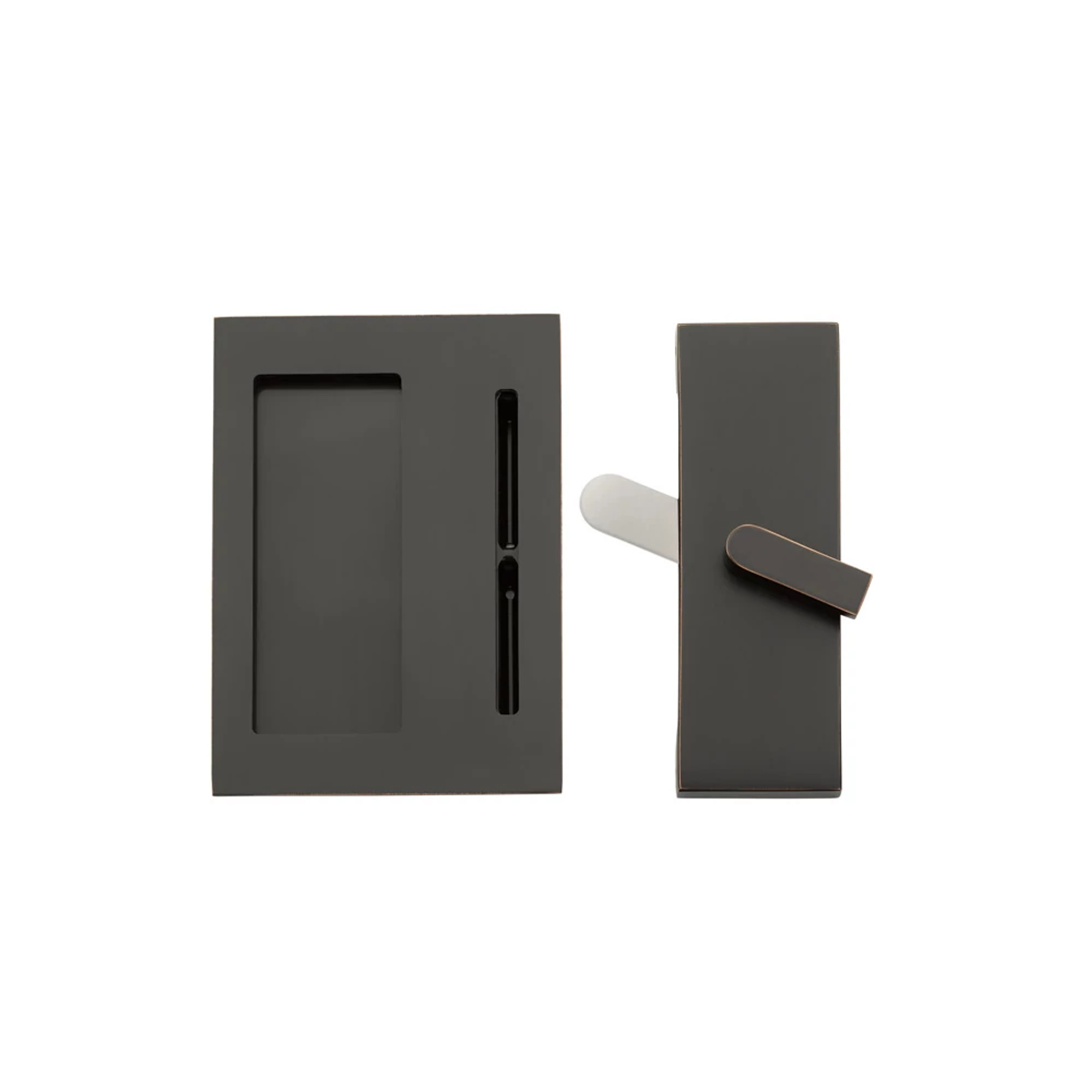
Emtek’s example mounts to the inside door-and-jamb arrangement and includes an emergency-release tool. Other products use different mounting patterns or release methods. Check thickness, overlap and receiver requirements for the specific version, not merely the brand name.
Ask whether the lock can be installed on the existing solid material without weakening a thin panel. A beautiful flush fitting may require preparation that the door cannot safely accommodate.
Hooks, cabin latches and surface bolts
A simple hook or bolt can serve a modest privacy or cupboard-retention purpose on a suitable door. Its strength depends on the fitting, screws and supporting material. A small decorative hook should not be represented as the equivalent of a purpose-designed security lock.
Think through access from both sides. A room containing a person needs an appropriate way to release the door without trapping them. A surface bolt accessible only from outside can be particularly unsuitable if someone may enter the space.
For children’s rooms, bathrooms and anyone who might need assistance, use hardware intended for that situation rather than an improvised hook arrangement. The convenience of installation is not the most important design requirement.
Can a barn door have a keyed lock?
Purpose-made keyed sliding-door hardware exists, but compatibility must be established for the actual leaf, jamb and travel. A conventional bored deadbolt designed to project into a hinged-door frame may not have a suitable receiver or operating geometry here.
For storage, identify whether you need authorization from outside while retaining suitable inside release. For an occupied room, a keyed system can create unnecessary complexity unless the application genuinely requires it and the arrangement is appropriate.
Do not drill a hole first and search afterward for hardware that reaches the frame. A supplier should confirm the complete layout, including the receiver and any required preparation, before the work begins.
Exterior sliding barn doors need a complete security assessment
A large exterior door may have exposed tracks, multiple panels, weather gaps and substantial weight. A lock controls only one aspect of that assembly. The surrounding construction and panel-retention features can remain limiting factors even when the lock body is robust.
Use hardware designed for the specific door type and environment, with appropriate mounting support. Check corrosion exposure, drainage and maintenance access. A lock intended for a dry interior bathroom is not suitable simply because it can be made to catch.
Our shed-security guide and farm-security guide help place the door within the broader storage and access plan. Valuable portable contents may need separate suitable restraint or secure indoor storage.
Measurements to send a hardware supplier
| Information | Why it matters |
|---|---|
| Door thickness and construction | Determines whether preparation and fixings have support |
| Overlap when closed | Determines whether the receiver can align |
| Gap from leaf to jamb or wall | Controls the necessary reach and mounting geometry |
| Track and guide model | Identifies permitted movement and compatible accessories |
| Opening direction along the wall | Checks handedness and usable placement |
| Room or building use | Separates privacy, storage and required exit functions |
| Photographs from both sides | Reveals interference with trim, handles or adjacent surfaces |
Include the full closed and open arrangement rather than only a close-up of the desired lock position. A supplier cannot assess travel interference from one photograph of a flat board.
Plan the installation before cutting or drilling
Obtain the exact product’s current template and verify printed scale where relevant. Mark both the operating component and receiver with the door in its intended closed position. Check that the location is usable by the people who need it.
Use only preparation permitted for the door construction. A hollow leaf may require reinforcement not apparent from its exterior, and a narrow stile beside glass can impose strict limits. Unknown internal construction is a reason to pause rather than use a deeper screw.
For a rented or rated installation, establish permission and approved repair requirements before work. A privacy upgrade should not invalidate a door’s required performance or leave an owner with unsupported holes.
Install without making the lock an alignment tool
Follow the product’s preparation and fastening sequence. Components should seat naturally against the intended surfaces. Do not tighten screws to bend a receiver toward a misaligned latch or use soft improvised packing where the product calls for a defined spacer.
Keep the track and guides in their approved configuration. If the door moves away from the lock as it closes, investigate the guide or stop rather than mounting the receiver at an artificial angle.
After fitting, slide the door fully open and closed with the lock disengaged. Check that handles and hardware do not strike the wall, molding or each other. Only then test engagement in the normal closed position.
Test privacy and emergency access separately
Have an authorized helper remain outside while the inside occupant tests the normal lock and release. Maintain a safe alternative arrangement so the test cannot create a lockout. The door should not need to be pushed sideways or lifted to operate.
Verify the documented emergency-release function without publishing or improvising bypass methods. Store the legitimate release tool or instructions where the responsible person can access them promptly, not inside the room they may need to enter.
For a bathroom, consider what happens if an occupant cannot assist. The lock should be selected and installed with that foreseeable situation in mind, rather than simply making it as difficult as possible to open from the other side.
Gaps, sound and privacy
A lock prevents intended movement; it does not eliminate the visual and acoustic gaps around a surface-sliding door. If complete privacy or sound control matters, assess the door’s overlap, wall clearance and any approved seals as a separate design question.
Do not fit improvised brush strips or blocks that interfere with the lock, guide or safe movement. Some rooms are better served by a different door system when their privacy needs exceed what the existing barn-door arrangement can reasonably provide.
Being honest about that limitation is better than purchasing increasingly complicated locks for a door whose geometry cannot meet the room’s requirements.
Troubleshooting after fitting
If the latch catches only when the door is pushed toward the wall, check guide alignment and the specified receiver spacing. If the door stops before covering the opening, inspect interference and stop position through the approved procedure. If screws loosen, examine the substrate and correct fasteners.
Do not file or bend a locking part until it happens to fit. That may reduce engagement or conflict with the manufacturer’s design. Contact the supplier with photographs and the actual measurements when the documented layout does not work.
If the door is difficult to slide even with the lock disengaged, address the track system first. The lock is not responsible for every problem that appears near it.
Maintenance and changes of use
Inspect visible fixings and normal movement when the effort or sound changes. Keep rollers, guides and lock components maintained according to their separate instructions; a lubricant suitable for one part may not be appropriate for another.
Review the hardware if a storage room becomes a bedroom, a family member needs easier access or the building’s use changes. A fitting selected for an unoccupied cupboard may be unsuitable for a room where someone can become trapped.
Keep product information and the installation record. A later repairer should not need to guess the lock’s purpose or dismantle a heavy door to identify a missing component.
Frequently asked questions
Can a sliding barn door be locked from both sides?
Appropriate hardware can provide different access functions, but the correct arrangement depends on whether the door serves privacy, storage or an occupied exit. Do not improvise two opposing bolts that can trap someone.
Is an emergency-release hole a security flaw?
On an interior privacy product it can be an intentional safety feature. That is why such a lock should not be mistaken for an exterior security mechanism.
Can I fit a normal deadbolt?
Not as a universal solution. The sliding leaf’s offset and lack of a conventional receiving jamb often require purpose-designed hardware.
Will a better lock remove the gaps around the door?
No. Visual privacy, sound transmission and locking are separate aspects of the door system.
What should I buy first?
Identify the door’s purpose and measure its closed geometry, then select a compatible complete lock-and-receiver arrangement. Repair unstable travel before adding the lock.