Best Anti-Theft Travel Wallets: Compact Wallets, Document Organizers and Money Belts
The best travel wallet is not necessarily the one with the most compartments or the largest RFID logo. A bulky organizer can keep documents orderly at an airport and become inconvenient during a day of sightseeing. A concealed belt can hold reserve items discreetly, but repeatedly opening it at every payment defeats much of that carrying strategy.
Choose the format for the job, then examine closure, fit, attachment and how you will recover if it disappears. This guide compares three manufacturer-documented examples rather than inventing a hands-on winner. Product features and availability were checked on November 1, 2026; confirm the exact version and regional listing before purchase.
Start with two jobs: daily access and reserve storage
Daily spending needs to be convenient enough that you do not leave the wallet on a counter while searching through papers. Reserve cash, a backup card and documents not needed repeatedly can be carried or stored separately in an appropriate secure arrangement.
Keeping every payment method, passport and recovery detail in one organizer makes one loss more disruptive. Separation is not a guarantee against theft, but it can preserve options when an ordinary wallet is misplaced. Do not use an unattended checked bag as the default place for essential identity documents or financial backups.
| Format | Best reason to choose it | Main tradeoff |
|---|---|---|
| Compact bifold or card wallet | Daily payments without carrying a large document case | Limited capacity and little protection if stored carelessly |
| Zipped travel organizer | Orderly document handling during transit | Bulk and concentration of important items |
| Under-clothing money belt | Discreet reserve storage when comfortably fitted | Less convenient for repeated public access |
| Neck or hidden pocket pouch | An alternative concealed-carry position | Fit, comfort and snag risks need consideration |
The correct format is one you can use without constantly removing or abandoning it. Comfort is not superficial when a product’s protection depends on being carried consistently.
Compact option: Pacsafe RFIDsafe bifold
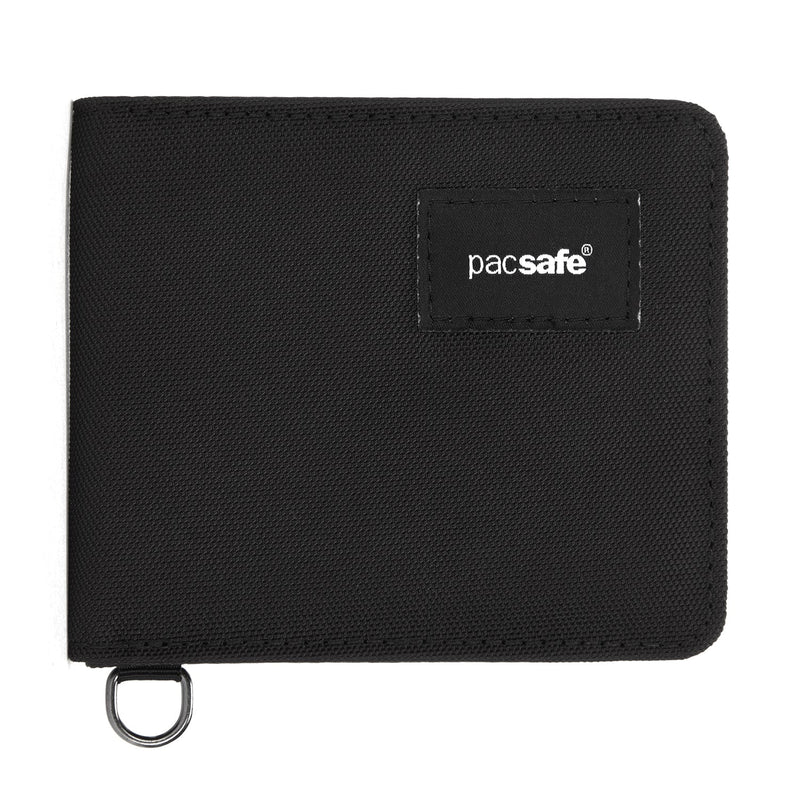
Pacsafe’s bifold specification lists three ordinary card slots, an ID window, a bill compartment and an attachment point. It describes a compatible cut-resistant wallet strap as a separate accessory. Check the included contents so that a photograph does not lead you to assume an extra strap arrives in the box.
This is a useful category for someone who wants a compact spending wallet rather than a passport organizer. Try it with the actual cards and notes you carry, and check that it fits the intended inside pocket without protruding or becoming difficult to retrieve.
A tether can reduce some accidental loss or casual separation when appropriately attached, but it does not make confrontation safe. Do not resist a violent robbery to protect a wallet or treat an accessory as a reason to keep all reserves in one place.
Document option: Pacsafe RFIDsafe travel wallet
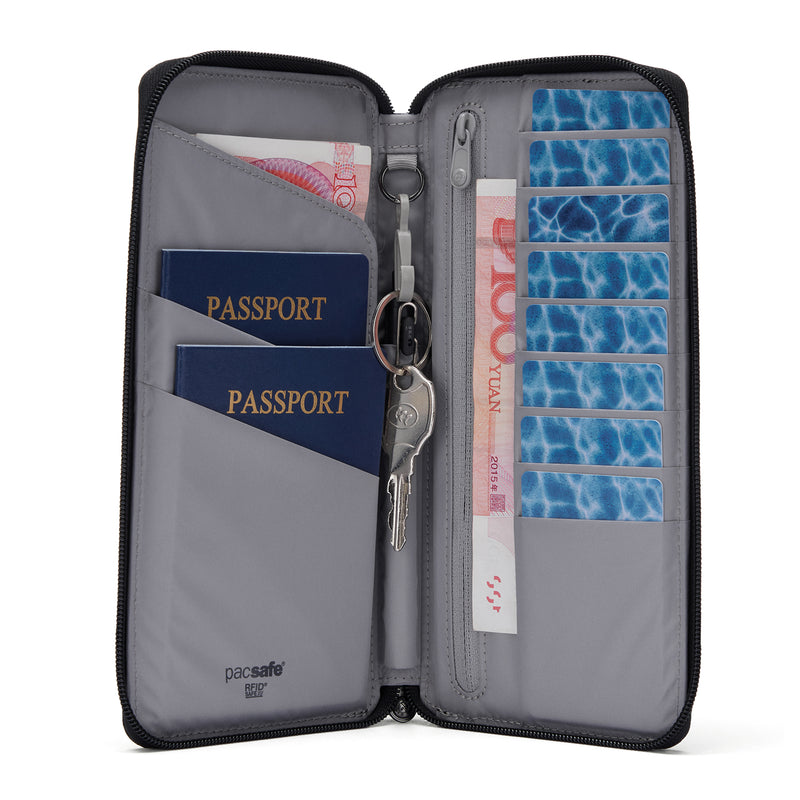
The RFIDsafe travel wallet is documented with two passport pockets, eight card slots, a zipped coin compartment, a pen loop and attachment points. It is a different carrying category from the compact bifold, not simply a larger version that will suit every trouser pocket.
It can make check-in or family document handling more orderly. The downside is that a single organizer can concentrate many essential items. Decide what stays in it during transit and what moves to a suitable separate reserve arrangement once you reach accommodation.
Check the dimensions with the passports and documents you actually use. Do not assume a product photograph proves that your phone, unusually sized documents and several bulky covers will all fit without straining the closure.
Concealed option: Eagle Creek Undercover RFID Money Belt
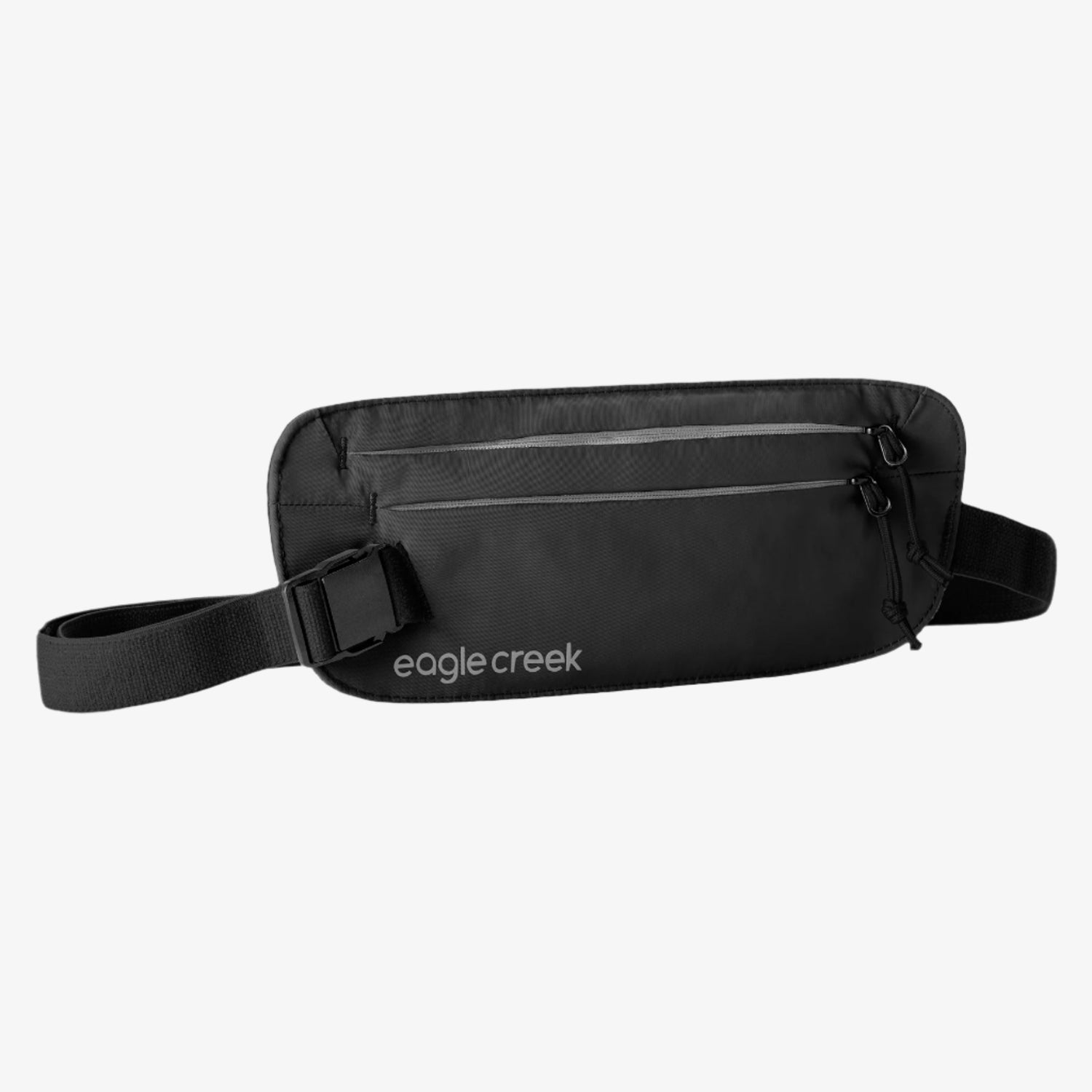
Eagle Creek’s current Undercover model has two zipped compartments, an adjustable elastic waistband and a documented external size of 28 by 10 centimeters. It is designed to be worn under clothing and can accommodate a passport according to the maker. Confirm the actual version rather than confusing it with an older similarly named product.
Test it at home with a realistic load. Sit, walk and wear the clothing intended for the trip. Overstuffing can make a discreet pouch conspicuous and uncomfortable, encouraging you to remove it later.
Keep ordinary spending access separate where practical. A money belt works differently from a day wallet; reaching beneath clothing repeatedly in a queue can expose the storage and slow transactions. Do not wear straps in a way that creates snag or entanglement hazards during activities.
RFID blocking is a limited feature, not complete identity protection
RFID-blocking material is intended to interfere with certain radio-frequency communication under the product’s stated conditions. It does not stop someone taking the wallet, copying information from a visible card, sending a phishing message or accessing a compromised online account.
Contactless payments also have their own protections. Mastercard describes transaction-specific cryptograms, while Visa explains that important authentication information is not simply readable from a bogus terminal. Those protections do not mean fraud is impossible, but they make sensational claims about effortlessly cloning an entire account misleading.
Do not pay for a bulky uncomfortable wallet solely because its packaging implies your identity otherwise has no defense. Prioritize carrying habits, provider alerts and account security. Our identity-theft guide explains the risks a physical wallet cannot address.
Closure and internal organization matter more in daily use
A wallet should close reliably with its intended contents. Check whether cards remain retained when opened, whether notes can be removed without dropping everything and whether a coin compartment creates unnecessary bulk. A zipper is useful only if it is actually closed.
Try the wallet with foreign notes and any required local identification before departure. A design comfortable for a few cards may not suit travel where cash or physical documents are used frequently. Avoid folding or damaging documents simply to force them into a fashionable size.
Separate frequently used items from reserves so you do not expose the entire contents at every payment. This is an organizational habit, not a guarantee against observation, but it can make handling quicker and less error-prone.
Where you carry it changes the protection
A premium wallet in an easily reached outside pocket can still be vulnerable. Choose a position that stays under your control and suits your clothing. A secure inside pocket may be more practical than a complex tether that you stop using after the first day.
Police.uk’s pickpocketing guidance emphasizes custody and warns that a zipped bag is not complete protection. Apply the principle to a wallet: do not leave it on a table, behind a chair or in an unattended bag because the product carries an anti-theft label.
A bag’s location matters too. Our travel-bag security guide covers cafés, transport and handovers. The wallet and the bag holding it are part of one routine.
Do not confuse water resistance with waterproof storage
A water-repellent shell or ordinary zipper does not establish that a wallet can be submerged. Check the exact manufacturer claim and closure procedure. Protect documents from sweat and rain through an appropriate arrangement without assuming that every travel product is a dry bag.
For swimming, choose a plan that does not introduce unsafe straps or distract you from water conditions. A waterproof pouch should be tested and used within its stated limits, but it is not a flotation or rescue device. Often the better answer is to take fewer valuables and use reliable storage or a trusted non-swimming companion.
Our beach-valuables guide separates custody, water protection and personal safety. A wallet purchase should not determine whether you enter water that is unsafe.
Arrange a useful backup without creating a new risk
Carry only the cards and documents needed for the activity, subject to the destination’s identification requirements. Keep a legitimate backup payment method in an appropriate separate secure place rather than assuming the same bag has two independent layers because it has two pockets.
Record provider contact routes and relevant document details securely. Avoid keeping card PINs with the cards or leaving full account information in a public photo album. A recovery record should help the owner, not turn a lost wallet into a complete instruction kit for misuse.
For travel documents, follow your own government’s advice about copies and replacement. A photocopy is not automatically a valid substitute for an original when an authority or carrier requires it.
Compare products without invented test scores
Use the exact dimensions, materials, closure and accessory list to narrow choices. Read reviews for usability patterns, but do not treat a star average as a certified theft-resistance measure. Ask whether a review actually tested a feature or merely repeated a manufacturer’s description.
These examples were selected to show different carrying approaches. We have not performed RF laboratory tests, cut-resistance tests or weeks of personal travel with each product. The recommendation is to compare the documented fit for your use, then test comfort and operation during a legitimate return period.
Prices and stock change by region and color. Check the total delivered cost and included accessories rather than relying on an old price in a search snippet. An accessory sold separately can change the actual cost of the setup you had in mind.
If the wallet is lost or stolen
Move to a safe place and contact card issuers through trusted channels to restrict affected cards as appropriate. Review recent transactions and follow the provider’s dispute process for anything unauthorized. Do not assume blocking one card secures every account whose information was in the wallet.
Report missing identity documents through the relevant official process. If abroad, use your country’s consular guidance and local reporting arrangements. Canada’s lost-belongings guidance is one primary example of how document replacement and incident reporting are separate steps.
Preserve records, but do not chase a suspected thief or confront someone based on a tracker location. Be alert to messages offering recovery in exchange for account credentials, payment or sensitive documents.
Which format would I choose?
For ordinary daily spending, I would start with a compact wallet that fits a controlled pocket and holds only what the day requires. For airport document handling, a zipped organizer can be useful if its contents are deliberately reassigned afterward rather than carried everywhere as one high-consequence bundle.
For reserve storage during appropriate activities, a comfortably fitted concealed belt can be sensible. It should not be overloaded or repeatedly accessed in public. The best setup may use more than one modest item with distinct jobs instead of one expensive wallet expected to solve everything.
A pre-trip fit check
- Load only the cards, documents and currency you intend to carry.
- Check closure, retention and normal access without spilling contents.
- Walk and sit in the clothing you expect to wear.
- Confirm any tether or strap is compatible and does not create a hazard.
- Separate daily spending from a suitable reserve arrangement.
- Store recovery contacts securely outside the wallet.
If the wallet is awkward during a calm test at home, it is unlikely to become easier in a crowded station. Choose a simpler arrangement rather than assuming discomfort is the price of being secure.
Frequently asked questions
Is an RFID wallet theft-proof?
No. Radio shielding addresses a limited communication function and does not prevent physical loss, pickpocketing or most account-management problems.
Should all passports and payment cards go in one organizer?
An organizer can help during transit, but concentrating every essential item increases the consequences of one loss. Plan appropriate separation and required access.
Is a money belt better than a normal wallet?
It serves a different job. It can be useful for concealed reserves, while a compact day wallet may be more practical for frequent payments.
What should matter most when choosing?
A format you can carry consistently, suitable closure and fit, controlled handling and a recovery plan. Marketing labels should not replace those checks.