Garage Door Won’t Close? Check Sensors, Obstructions and Reversal Before Adjusting Anything
.sl-garage table{border-collapse:collapse;width:100%;margin:24px 0}.sl-garage th,.sl-garage td{border:1px solid #bdcbd0;padding:12px;text-align:left;vertical-align:top}.sl-garage th{background:#eef4f2}.sl-garage .table-scroll{overflow-x:auto}.sl-garage figure{max-width:760px;margin:28px auto}.sl-garage img{max-width:100%;height:auto;display:block;margin:auto}.sl-garage figcaption{font-size:14px;line-height:1.6;color:#425c63;padding-top:10px}
The door starts down, stops and returns upward. It is tempting to increase closing force or hold a control until the door finally reaches the floor. That can conceal the very condition the safety system is reporting. Start by identifying where the movement fails and what the opener’s actual indicators say.
A garage door that will not close needs separate checks for the clear opening, photoelectric sensors, door condition and the selected control path. Do not bypass a safety device or force the motor against a fault. This guide starts with safe observations and distinguishes ordinary obstructions from problems requiring a qualified technician.
Stop immediately for visible mechanical damage
Keep people and animals clear if the door hangs unevenly, a cable is loose or broken, a roller is displaced, or a spring appears damaged. Do not continue cycling the opener, pull on the door or release it from the motor to see whether it falls into place.
High-tension components and their attachments need appropriate professional handling. Clopay’s safety checklist warns about the door’s springs, cables and associated hardware. A keypad or sensor adjustment is not a repair for that damage.
If someone is trapped or there is an immediate danger, contact the appropriate emergency service. For a non-emergency fault, arrange service and discuss how the opening can be made safe without creating a new hazard.
Describe the failed movement precisely
Observe from a safe location with no one in the door’s path. Does the opener ignore the command, click without movement, stop partway, or reverse just after touching the ground? Those observations point to different investigations.
| Symptom | Useful next check | What not to do |
|---|---|---|
| No normal close movement, sensor warning present | Clear opening, sensor condition and exact diagnostics | Disable or relocate sensors away from the protected opening |
| Starts closing, then reverses at varying heights | Intermittent obstruction, alignment, wiring or mechanical condition | Increase force to overpower it |
| Reaches the floor and immediately reverses | Travel setting, floor obstruction and door condition through the manual or technician | Keep repeating cycles without diagnosis |
| Wall operation works normally, one remote does not | The individual control and lock mode | Assume every failure is a sensor problem |
| Problem occurs at a particular sunny time | Receiving-sensor exposure and approved mitigation | Cover the sensor lens or bypass the beam |
| Door is crooked, grinding or visibly damaged | Professional mechanical assessment | Disconnect an unstable raised door from the opener |
Record the model, displayed message and any flash pattern before changing anything. A short factual description can save a technician from arriving with the wrong parts.
Clear the opening and check ordinary obstructions
Look for bins, tools, bicycles, a vehicle bumper or other objects crossing the protected opening. Small items can interrupt the beam while being easy to miss from inside a car. Move accessible objects away while the door is stationary and nobody is operating it.
Check the floor for debris or accumulated material without reaching beneath a moving door. Do not chip frozen components, pull a stuck panel free or interfere with the tracks under load. A door stuck to the ground or visibly binding needs an appropriate assessment.
After removing a clear ordinary obstruction, test normal operation once with everyone out of the path. If the same fault remains, continue diagnosis rather than assuming the safety system is too sensitive.
Identify the sensors before interpreting their lights
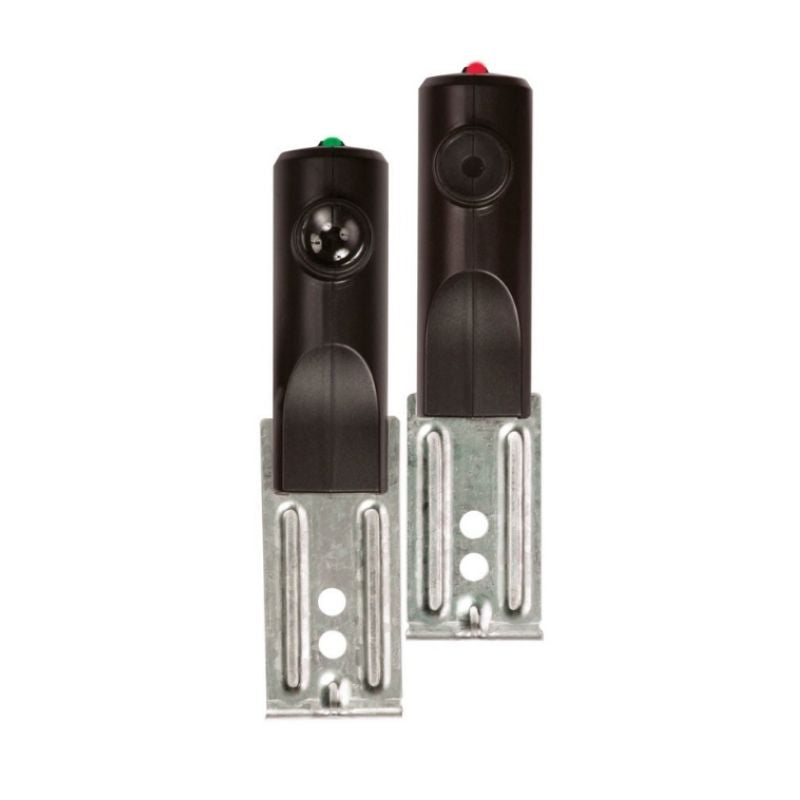
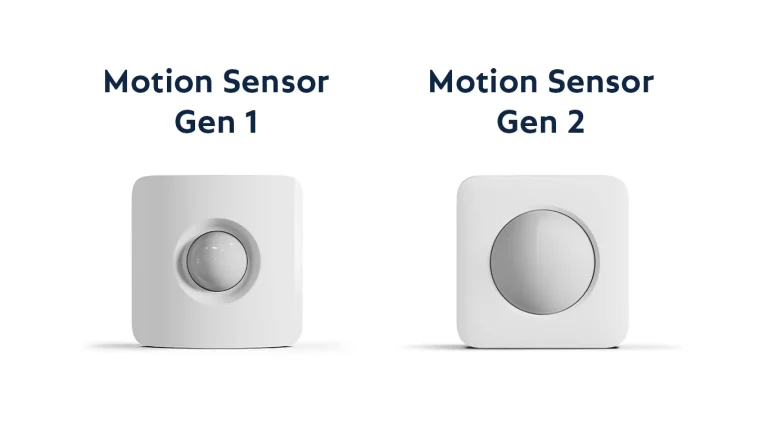
Photoelectric systems use a sending and receiving arrangement across the opening. Their indicators help identify power and communication, but the colors are not a universal language. Read the sensor and opener model instructions together.
Chamberlain’s sensor-identification guide lists common amber-sender and green-receiver examples, but also identifies an older pair with green lights on both units. Even within one brand, the exact generation matters.
A dark indicator can indicate a power or wiring problem rather than simple misalignment. Do not keep rotating a sensor whose supply is absent, and do not move it above its prescribed protective position to obtain an apparently stable light.
Clean and inspect accessible sensor surfaces
Check for visible dirt, webs, condensation or physical damage. Use the manufacturer’s approved cleaning method, keeping liquid out of the electronics. Avoid abrasive cleaners, solvents or sprays intended to repel insects from the lens.
Look for a bracket displaced by a bicycle, storage bin or recent work. A sensor that is loose enough to move when the door vibrates can appear aligned while the door is still. Do not tighten unrelated track or spring hardware as part of this inspection.
When adjustment is permitted for the owner, follow the exact isolation, mounting and alignment procedure. Mains and battery power can both matter; do not assume unplugging the wall supply makes every component inactive.
Alignment is not just making an LED look steady
The two units must be correctly positioned across the intended opening and secured to their approved supports. Pointing them toward one another elsewhere, mounting them together or moving the beam above an obstruction defeats the protective arrangement.
Chamberlain’s alignment instructions specify its sensor placement and warn that the required protection must not be disabled. Use the corresponding instructions for your system and obtain help if wiring or brackets need repair.
Once correctly assembled, perform the required manufacturer tests with a suitable test object and method—not a person or body part. A stable indicator is useful, but the whole safety function still needs verification.
Sunlight can create a time-specific problem
If closing fails only during a particular period of direct sunlight, note which sensor is exposed and the state of its indicator. A timing pattern can be more informative than repeatedly replacing remotes. Rain, shade and seasonal sun angle can change the symptom.
Chamberlain’s sunlight guidance discusses receiving-sensor interference and approved measures for its supported equipment. Suitable shields or professionally corrected positioning may help; an improvised cover over the optical path does not.
Do not relocate the sensors beyond their prescribed geometry or swap wiring without the proper instructions and competence. The solution must retain protection throughout the opening, not simply make the door close during the troublesome hour.
Read diagnostic flashes for the actual hardware
Count the indicated groups and distinguish motor-head lamps, arrow indicators and sensor lights. They may report different information. Photograph or record the sequence from a safe position and look it up under the exact model and revision.
Some older Chamberlain closing-fault descriptions refer to ten flashes of the work light, while newer equipment does not necessarily use that signal. The absence of that older pattern is not proof the safety sensors are healthy. Use the current manufacturer diagnostic guide.
Do not transplant a code table from another brand. A precise model number and repeated code are more useful to support than a general statement that the garage light is blinking.
When the door reverses at the floor
Note whether an obstruction, weather seal, changed flooring or recent adjustment affects the fully closed position. A travel-limit problem is one possibility, but the mechanical condition must also be checked. Increasing force without diagnosis can make a dangerous situation worse.
Use the manufacturer’s owner-permitted procedure or a qualified technician for travel and force calibration. Correct calibration includes the required safety checks afterward; it is not simply turning an adjustment until the door remains down.
If flooring, the door or the opener has recently been replaced, provide that history to the installer. The new combination may need correct commissioning rather than another unplanned adjustment.
When only remote or app closing fails
A handset that fails to operate either direction needs a control-path check. Our remote guide separates battery, enrollment, lock mode and interference. A keypad with a different symptom has its own diagnostic sequence.
An app may impose additional conditions for unattended closing, including required warnings or accessory status. A local control working does not establish that every remote function should work identically. Use the smart-controller guide and the exact product’s error message.
If closing works only through a special override or continuous-pressure method, do not adopt that as the everyday repair. Have the cause corrected so normal operation and the required protection both work.
Do not overlook the door’s mechanical condition
Observe unusual noises, scraping, panel damage and uneven movement without touching loaded hardware. The opener may be reacting appropriately to resistance. Rollers, tracks, hinges, cables and the counterbalance system require different servicing decisions.
Clopay explains why springs help balance the door. A stronger motor or larger force setting is not a substitute for restoring that balance. High-tension work should be handled by a qualified technician.
Do not release an open or unstable door to conduct an improvised balance test. The proper test depends on the condition and the manufacturer’s procedure; an apparently simple handle or cord can disconnect a substantial load.
Manage an unsecured opening without creating another hazard
Tell the service provider whether the door is currently open, partly closed or stable at the floor. Ask for an appropriate making-safe arrangement and estimated service scope. Do not improvise clamps, ropes or stacked objects to restrain a damaged door.
Secure other accessible entrances and portable belongings while preserving normal escape. A camera can document activity, but it does not physically close the vehicle opening. Our garage-security guide covers the surrounding access points.
For shared premises, notify the responsible manager and affected users. A door that operates unpredictably should not remain available for unsuspecting people to activate.
Record the repair and repeat the safety checks
| Check | What to retain |
|---|---|
| Original fault | Movement pattern, time, weather and exact diagnostics |
| Actual correction | Cleared obstruction, repaired wiring, approved adjustment or replaced part |
| Normal control | Ordinary opening and closing work without a workaround |
| Safety verification | The manufacturer’s required tests pass |
| Other inputs | Remote, keypad and supported app operation remain correct |
| Follow-up | Any maintenance or service still required is documented |
Retest during the condition that used to trigger the fault where appropriate, such as the relevant sunny period. A successful evening close does not establish that an afternoon interference problem has been resolved.
Frequently asked questions
Should I increase the closing force?
Not as a generic fix. Find the obstruction, alignment, travel or mechanical cause and follow the approved calibration and safety-test procedure.
Do both sensor lights need to be green?
No universal color rule applies. Identify the sensor model; some systems intentionally use different colors for sending and receiving units.
Why does the door open but refuse to close?
The closing safety path can prevent downward operation even when opening remains available. Check the exact diagnostics and physical scene rather than assuming the motor is healthy in every respect.
Can I bypass the sensors temporarily?
Do not defeat the protective system as a repair. Keep the area safe and use the manufacturer or qualified service provider to restore correct normal operation.