

How Far Can Security Cameras See at Night? Range, Detail and Real-World Testing
A camera advertised with 100 feet of night vision may show that someone is standing near your gate without recording enough detail to recognize their face. The marketing number usually describes an illumination-related capability under stated conditions, not a universal identification distance. Those are very different promises.
The useful answer to how far a camera can see at night begins with what you need to see. Detecting movement, recognizing a familiar visitor and reading a vehicle registration require different detail. This guide explains the limits that matter, shows how to think about coverage and gives you a practical test for your own entrance.
There is no single nighttime range
At least three distances are relevant: how far the scene is illuminated, how far the system can detect the event you care about, and how far away the recorded image contains useful detail. They can be very different on the same camera.
A battery camera’s motion sensor may fail to wake for a distant subject even when an on-demand live view shows that person. A camera can also detect movement and save a clip whose face is too small or blurred to identify. Keep those functions separate when comparing specifications.
| Claim or observation | What it can tell you | What it does not prove |
|---|---|---|
| Advertised infrared distance | The maker’s stated illumination capability | Recognizable faces at the full quoted distance |
| Motion-detection range | Conditions under which a trigger may occur | Enough image detail for identification |
| High resolution | The number of recorded pixels in a supported mode | How many pixels fall on a distant subject |
| Clear static night image | The scene can look sharp without movement | A walking person will remain sharp |
| Recognizable close-up | The camera works for that specific close position | The same result at the far end of a driveway |
A useful purchase specification states the task and location together: record a recognizable visitor at this gate, or show whether a vehicle enters this space. That is more actionable than requesting the longest-range camera in the catalogue.
What infrared night vision actually does
Conventional day-and-night cameras can use near-infrared illumination to form an image when visible light is insufficient. This is different from a thermal camera sensing emitted heat. An ordinary infrared night-vision camera still needs suitable light reaching the scene and returning to its sensor.
Axis’s infrared-surveillance explanation distinguishes these technologies and describes built-in versus separate illuminators. For a homeowner, the key point is simple: an infrared LED is an illumination source, not a mechanism that makes distance irrelevant.
Light distribution matters. A strong nearby reflection can dominate the image while the gate remains dim. Vegetation, weather and surfaces can influence what returns to the camera. A single maximum-distance figure does not describe every part of that scene equally.
Why the subject gets less detailed with distance
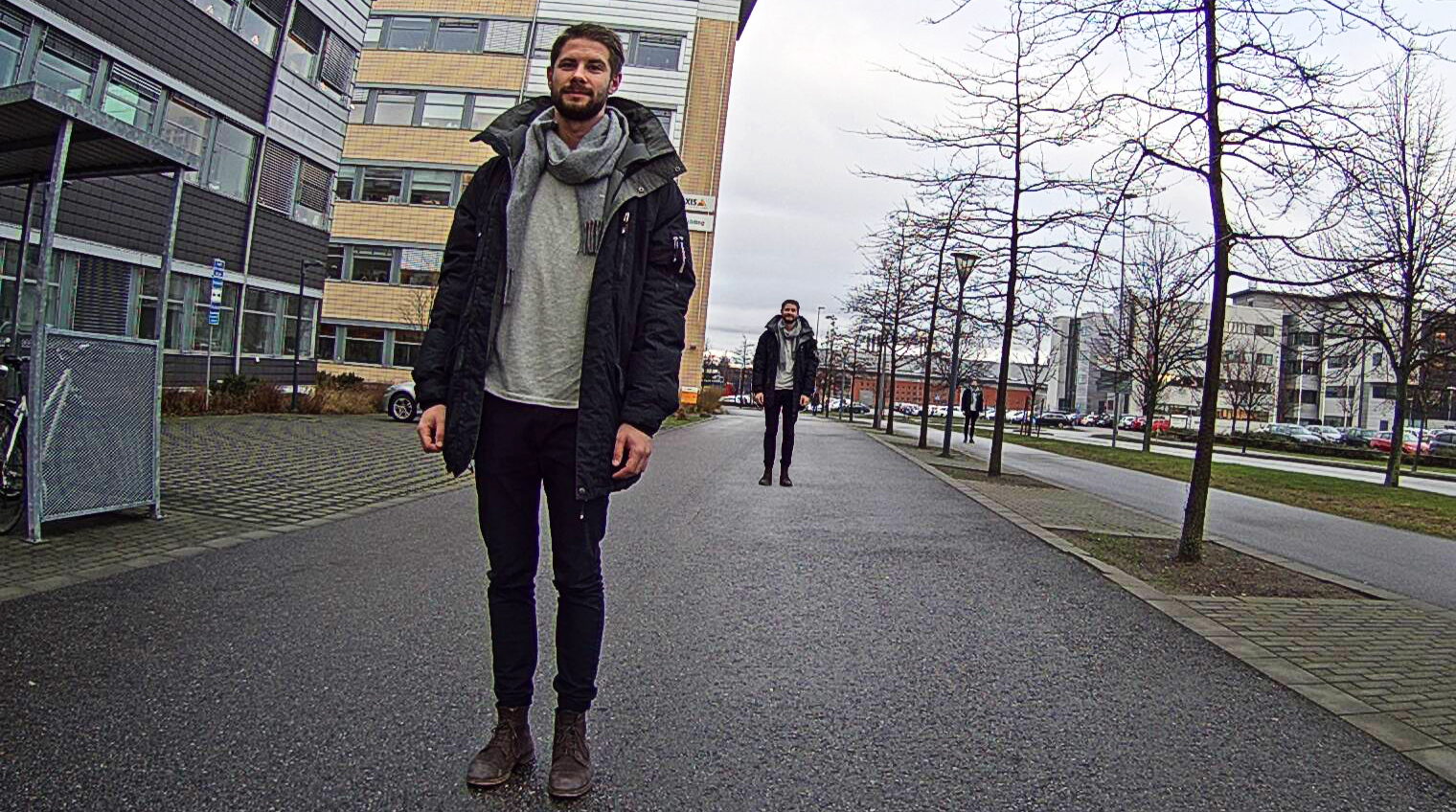
A fixed-resolution image contains a finite number of pixels. When the field of view covers a wider section of the property, each object occupies a smaller part of that image. At increasing distance, a person’s face generally occupies fewer pixels, even though the overall picture may look impressively broad.
Digital zoom enlarges those recorded pixels. It does not recover missing original detail. A face can therefore look larger on your phone while remaining equally uninformative. Optical selection and placement must provide enough useful information before the recording is made.
A simple coverage calculation
Suppose a recorded image is 1,920 pixels wide and the scene at the position you care about spans 12 meters. Dividing 1,920 by 12 gives an average of 160 pixels per meter across that plane. If the view spans 24 meters instead, the same image width gives about 80 pixels per meter.
This is a simplified geometric illustration, not an identification guarantee. Lens distortion, perspective, focus, compression and lighting affect the actual result. But it shows why doubling the width of the scene can reduce the detail available on the same subject.
Similarly, increasing resolution can help only when the rest of the imaging chain preserves useful detail. A noisy, blurred or heavily compressed high-resolution file can be less useful than its pixel count suggests.
Detection and identification standards are planning tools
Older guides often refer to DORI categories and pixel-density thresholds from IEC 62676-4:2014. Standards have evolved: Axis’s 2025-based planning explanation describes updated operational categories and also warns that pixel density alone cannot guarantee the outcome.
For a domestic installation, you do not need to memorize a standards table before buying a camera. Define the evidence you need and test it. For a professional system with a specified recognition requirement, have the designer identify the applicable standard and document how the installation meets the whole requirement.
Do not treat a number copied from a diagram as a promise that a blurred moving face becomes identifiable. Planning metrics and real recorded performance should support each other.
The lens determines the coverage tradeoff
A wider lens is useful for showing a broad area, while a narrower view can concentrate detail on a more limited route. A varifocal lens may let an installer tune that balance within a range. There is no universally best focal length independent of sensor size, mounting distance and the required scene.
For example, a camera above the garage may need to show the driveway generally, while a second camera near the entrance captures visitors more closely. Trying to get both an expansive overview and detailed distant faces from one wide view can be an unrealistic specification.
Camera housing shape does not settle this question. Read our dome, bullet and turret comparison to separate mounting design from lens and sensor capability.
Mounting height and angle can waste available detail
A very high camera can be difficult to reach, but it may mostly record the tops of heads. The line of sight to a face or registration plate matters as much as the object’s size in the image. Obstructions and steep angles can hide useful features even when the subject is nearby.
Test the proposed position before permanent cable routing. Have someone follow the actual approach and look naturally toward the entrance rather than posing directly at the lens. Review how much of the face is visible during ordinary movement.
Our camera-placement guide explains how to choose coverage areas. The purpose is not to place every camera at one universal height but to match the scene and maintain safe installation access.
Motion blur can shorten the useful range
A camera may compensate for low light with a longer exposure, producing a bright static scene while moving people smear. That problem becomes particularly important when the subject already occupies a small part of the image. You may see that someone passed without preserving useful facial detail.
Compare a moving and stationary subject under the same lighting. If the parked vehicle is sharp but a pedestrian is blurred, focus may not be the main issue. Better illumination or supported exposure adjustments may help more than increasing digital sharpness.
Use our nighttime blur guide for diagnosis. A frame-rate setting and an exposure duration are different controls, and increasing one does not automatically correct the other.
Visible lighting versus infrared illumination
Visible lighting can preserve useful color information when the camera and scene support it. Infrared may provide a less conspicuous monochrome view. Neither is universally better: the result depends on illumination distribution, reflections, subject movement and what evidence matters.
A bright spotlight can help near the porch but leave a distant gate poorly lit. A light aimed toward the lens can cause glare. A motion-activated light may also illuminate only after the visitor has already entered the scene, making the beginning of the event less useful.
Test the lighting that will actually remain in use. Do not evaluate the camera with a temporary torch aimed at the subject, then expect the same result during ordinary operation.
Can an external infrared illuminator extend range?
It can improve illumination in a suitable system, but it must be compatible with the camera and scene. Beam coverage, wavelength sensitivity, mounting, power and safe environmental installation all matter. A narrow bright spot may illuminate the wrong area or leave the edges unhelpful.
More infrared does not add optical detail to a person who is too small in the frame. You may make the distant subject brighter without making them more recognizable. Assess the lens and pixel coverage before treating an illuminator as the missing answer.
Use a qualified installer for specialized long-distance requirements. Avoid products whose range claims omit the conditions or imply that any camera will gain the same benefit.
Weather and reflections change the result
Rain, fog, dust and surfaces near the camera can scatter illumination and reduce contrast. A web close to the lens may appear as a bright moving shape while the real scene is dark. A clean lens and appropriate aiming remain important even on an expensive model.
Check conditions that are normal for the property, not only a clear test night. If the camera is exposed to recurring spray or condensation, choose an appropriate housing and mounting location. Follow the manufacturer’s cleaning and servicing instructions.
Filming through a window introduces additional problems. Read our through-glass guide before assuming the window is transparent to both the camera’s illumination and its motion sensor.
Number plates are a separate challenge
A general-purpose overview camera may show a vehicle clearly without recording a readable plate. Plate angle, movement, reflective surfaces, headlights and exposure requirements can make this a specialized task. Do not infer plate-reading range from the camera’s advertised infrared distance.
If plate evidence is essential, specify that task explicitly to a qualified supplier. Ask for footage under representative speeds and lighting, and confirm the exact model and settings needed. A promotional image of a stationary vehicle in favorable light is not an adequate acceptance test.
Keep local privacy and recording requirements in mind. The ability to point a camera toward a road does not by itself settle whether the proposed collection and use of footage is appropriate.
Do not forget the saved file
A live high-quality preview can differ from the stream actually recorded. Check the recorder’s resolution, quality profile and compression settings, then export an original sample. A low-bandwidth phone preview may look poor even when the original is adequate; the reverse can also occur.
Review the file on a suitable display without first sending it through an app that recompresses video. Confirm that useful footage is retained for the required period and that the household knows how to retrieve it.
A camera that could have captured detail but was configured to save only low-quality clips has not met the practical requirement. Storage and export are part of usable range, not administrative afterthoughts.
A repeatable nighttime range test
- Choose the exact locations where the footage needs to be useful.
- Measure or record their approximate distance from the camera.
- Have a consenting helper walk the normal approach at ordinary speed.
- Include brief stationary moments to distinguish motion blur from general softness.
- Check the event log, original saved footage and alert delivery separately.
- Repeat in the usual nighttime lighting and relevant weather where safe.
- Adjust one variable, then repeat the same route.
Record the outcome in plain language: useful face detail at the porch, only a silhouette at the gate, or reliable vehicle detection without a readable plate. That is a more honest and actionable specification than one maximum-range number.
What to change when the far end is not useful
Consider moving the camera closer, narrowing the view with an appropriate lens, improving suitable illumination or adding a separate camera for that location. Each has a cost and coverage tradeoff. A closer camera may solve the detail problem while leaving the overview to the original unit.
Do not buy a replacement solely because its label promises a longer infrared distance. Ask how its optics, recording quality and installation will meet the task the current camera fails. Our night-vision improvement guide provides a commissioning sequence before you spend more.
Frequently asked questions
Does 100-foot night vision mean faces are recognizable at 100 feet?
No. Illumination capability and usable identifying detail are different. Test the actual scene and recording.
Can a camera see in complete darkness?
A suitable conventional camera can use compatible artificial infrared illumination, while thermal systems operate differently. The exact hardware and lighting arrangement determine the result.
Will digital zoom improve distant evidence?
It enlarges recorded information but does not recreate detail that was never captured. Improve optical coverage or placement where necessary.
Is 4K always better at night?
Not automatically. Optics, sensor behavior, exposure, illumination and compression affect whether those pixels contain useful detail.
What is the best distance to mount a camera from an entrance?
There is no universal number. Choose a position that records the required detail and angle, then verify it with a realistic daytime and nighttime test.


