

How to Lock Up a Skateboard: Safer Storage, Compatible Racks and Theft Prevention
A skateboard is easy to carry away and does not offer the same obvious frame-locking point as a bicycle. A cable draped around a wheel or truck can look reassuring while failing to retain the complete board in the way you expect. The first question should therefore be whether the board needs to be left outdoors at all.
For a short stop, keeping it with you where permitted is often the simplest arrangement. For a regular commute, a suitable locker, supervised storage or a dedicated skateboard rack may be more practical. This guide explains how to evaluate those options, what a lock actually needs to secure and how to prepare for recovery without treating any small accessory as theft-proof.
Choose storage around your real journey
Think about the places where you stop: school, work, a gym, shops or a transport station. Each may have different rules about bringing a board inside or using exterior fixtures. Check before relying on a plan that will be refused when you arrive.
For example, UC Riverside Recreation’s published policy allows skateboards in designated racks or lockers while applying different restrictions to certain powered devices. That is one facility’s arrangement, not a rule for every campus or gym. Ask the actual venue about your board and intended storage.
If a location has no suitable storage, consider changing the route, carrying arrangement or transport choice for that trip. Repeatedly leaving an expensive board in a poor improvised spot is not made sensible by buying another thin cable.
Compare the main options
| Option | Where it can make sense | What to check |
|---|---|---|
| Carry the board with you | Short visits where the venue permits it | Safe handling and no obstruction to other people |
| Suitable locker | School, work or gym with permitted storage | Internal size, sound door and reliable locking |
| Staffed or supervised storage | A venue with a genuine handover process | Who accepts responsibility and how collection is verified |
| Dedicated skateboard rack | Recurring parking with compatible retaining hardware | Actual board fit, anchor support and the lock required |
| Portable locking accessory | A limited outdoor stop where the product suits the board | Whether the complete board remains retained and the fixed point is suitable |
| Unsecured rack or cubby | Convenient organization under appropriate supervision | Do not mistake it for controlled access |
The best choice is the one that works consistently in the real location. A secure locker you cannot use during your arrival hours is not a dependable commuting plan.
Understand what the lock is retaining
A skateboard has a deck, trucks, wheels and fasteners. Some parts are removable for ordinary maintenance. A restraint around one component should not automatically be described as securing the entire board or every valuable part.
Follow the locking product’s intended arrangement and check that the board cannot simply slide out through normal clearance. Do not rely on a loop that only looks tight from one angle. Conversely, do not overtighten an improvised clamp until it damages the deck or changes its structural condition.
A portable cable can provide a modest obstacle in some arrangements, but it is not equivalent to a well-supported purpose-designed system. Be honest about the intended duration and value exposed rather than treating the presence of a lock as a complete answer.
Dedicated racks can solve the awkward geometry
A skateboard-specific rack can hold the board in a way that an ordinary bicycle stand does not. The design still needs to match the board’s dimensions and use an appropriate lock. A rack intended mainly for display may not provide the same retention as one designed to accept locking hardware.
Mottez’s M059SMUR wall rack is a documented example of a single-board storage product that accepts a separate padlock, cable or U-shaped locking system. Its page states that locking hardware and wall fixings are not supplied. That means the complete installation must be specified rather than judged only by the rack’s price.
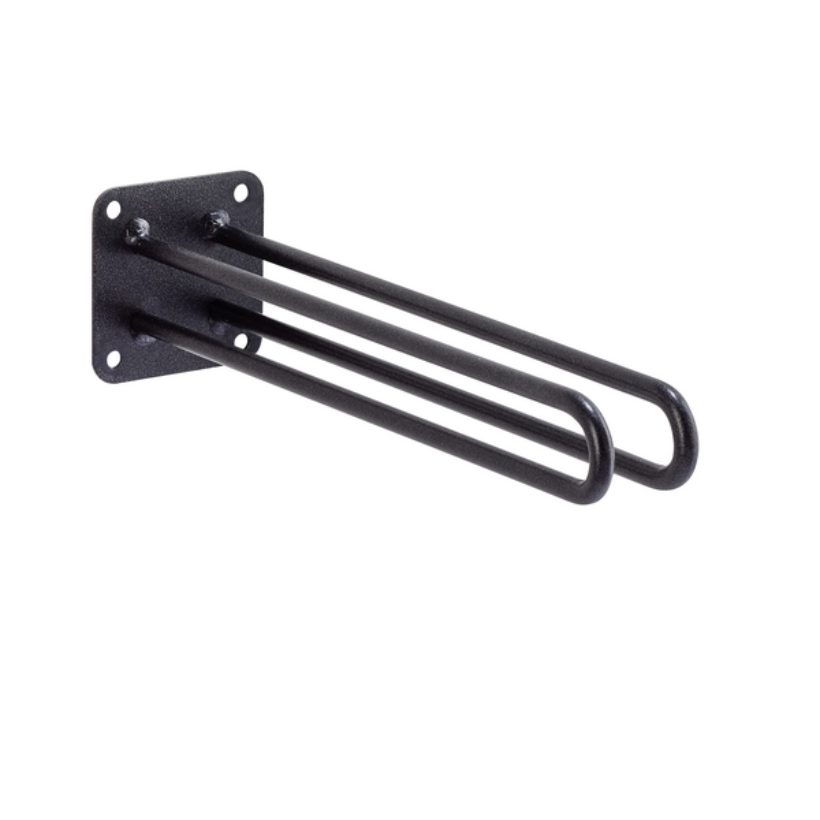
Do not assume every longboard, unusual deck or electric board fits a product described broadly as a skateboard rack. Ask for the actual compatibility information and test the permitted arrangement before relying on it.
The anchor is part of the security system
A rack needs appropriate support in the wall or other structure. A strong-looking steel holder attached to weak trim is not a sound installation. Identify the substrate and use the manufacturer’s specified fixing approach or a competent installer.
Obtain permission before drilling at school, work, in a rented home or in a shared building. Do not attach a board to equipment that must remain accessible, a fragile sign or a fixture that can simply be moved away.
Keep emergency routes clear. The University of North Dakota’s wheeled-device guidance is one example of rules prohibiting storage that blocks entrances, exits, stairs or other required routes. The relevant principle applies to selecting a safe location, while each venue’s actual policy must still be checked.
Choose the padlock for the rack
Measure the locking opening, required shackle clearance and space for the lock body. A large padlock that does not close correctly is not a stronger installation. Do not force a shackle through a fitting or leave the rack partly open to accommodate it.
Use a product intended for the environment. Outdoor storage exposes hardware to moisture and contamination, while a school locker may have its own approved-lock policy. A resettable combination can be convenient, but the code must be handled and reset through the correct process.
Our locker-lock guide explains keyed, combination and managed systems. Those choices remain relevant when a rack or storage cabinet accepts a padlock.
Indoor lockers: measure the board, not just the door
A board may pass through a locker opening but still prevent the door from closing because of wheel or truck clearance. Measure the full board and any bag or protective arrangement you plan to use. Do not wedge it into a position that presses against the latch.
Inspect the locker door, hinges and locking point before storing the board. A damaged cabinet is not repaired by your personal padlock. Ask staff for another suitable space when the door does not secure normally.
Confirm the permitted storage period. Some facilities clear day-use lockers after closing, so a missing board may have been moved through an authorized procedure rather than stolen. Our locker-use guide explains the importance of understanding the venue’s process.
Carrying the board without creating another problem
A board bag or compatible carrying strap can make it easier to keep the board with you, but it is not a security enclosure. Use an arrangement intended for the board’s weight and shape and keep it under your control.
Do not leave the board where wheels can roll into a walkway or where grip tape damages furnishings. Ask the venue where it can be placed rather than assuming that bringing it indoors permits leaving it anywhere.
For a workplace or classroom, agree a consistent storage spot with the responsible person. An arrangement that creates inconvenience for others is more likely to be removed or prohibited later.
At the skatepark
Keep the board and personal belongings within a practical supervised routine. A crowded park can contain boards that look similar, and ordinary confusion is possible alongside theft. Distinctive identifying records help, but they do not replace keeping control of the equipment.
Avoid leaving an expensive second board unattended while riding another. If a friend agrees to watch equipment, make the handover clear rather than assuming everyone in the group is supervising it.
Do not respond to a missing board by accusing the nearest unfamiliar person. Check with the venue or park staff where present and record what was actually observed.
Electric skateboards need additional care
An electric board adds a battery, drive components, controller and sometimes an app account. Confirm the manufacturer’s storage and charging requirements and the destination’s policy before bringing it indoors. Some facilities distinguish powered boards from ordinary skateboards because of operation and battery concerns.
Do not drill into the deck, battery enclosure or wiring areas to create a lock point. Do not clamp a product around a component the manufacturer has not approved for that use. A theft-prevention modification must not compromise the board’s structural or electrical safety.
Keep the remote or authorized control device with you, but do not assume it immobilizes the complete board against being carried away. An app lock and physical storage perform different functions.
Protect removable accessories
Lights, remotes, bags and other accessories may be easier to remove than the board itself. Take portable valuables with you where practical, and include important items in the ownership records.
Do not leave a charger operating in an unsuitable or unauthorized storage area merely because the board is locked there. Follow manufacturer and venue instructions for power and supervision.
If the board or an accessory is recovered after suspected interference, inspect it appropriately before riding. A missing fastener, damaged battery enclosure or altered component can make an apparently intact board unsafe.
Document ownership before a theft
Photograph the deck graphic, underside, trucks and distinctive marks. Keep the receipt and any serial or product identifiers where they will remain available without the board. For a customized setup, record valuable components as well as the deck.
Police.uk’s property-recording advice recommends photographs, serial numbers and purchase records to support ownership identification. Check an appropriate local registration or marking scheme where available.
Use a marking method compatible with the board and avoid publishing unnecessary home-address information on its exterior. Do not engrave or drill structural parts without manufacturer approval. Identification can support recovery; it does not physically retain the board.
What a tracker can add
A suitable location device may help you find a misplaced board or provide information after theft, but it depends on its technology, power and communication conditions. A map marker can be delayed or imprecise.
Fit the device through a safe, permitted method that does not interfere with riding or electrical components. Protect its account and keep recovery information available. Do not assume every consumer tag provides continuous real-time location.
If theft is suspected, share useful information with the appropriate authorities or venue. Do not follow a suspected thief, enter private property or arrange a confrontation based on a location signal.
If the skateboard is missing
Check whether staff moved it under a storage policy, whether an authorized friend has it or whether it was left at a previous stop. Establish the last confirmed location and time without assuming a cause before checking the facts.
Report suspected theft through the relevant facility, campus or police process. Provide photographs, identifiers, purchase records and any original footage. Keep the report reference for follow-up or an insurance claim.
Be cautious about recovery messages asking for payment, passwords or codes. Verify through official channels rather than trusting a stranger who sends a photograph resembling your board.
Insurance and valuable setups
Check whether your policy covers the board away from home, unattended outdoor storage, electric-board components and modifications. Conditions and item limits vary. A lock being advertised as approved does not establish that every storage arrangement satisfies your policy.
For an unusually valuable or irreplaceable board, the sensible choice may be not to leave it unattended in a public place. More expensive hardware cannot compensate for an unsuitable anchor or a venue that offers no secure storage.
Keep records of the actual setup and update them when components change. A receipt for a basic complete board may not describe later upgrades accurately.
What I would choose for regular commuting
For brief errands where the venue permits it, I would keep the board with me. For school or work, I would arrange a suitable indoor locker or a compatible dedicated rack before making the board my normal commute.
For home storage, a sound, properly installed rack in a secure area can organize the equipment and add controlled access. For unavoidable outdoor stops, use an appropriate designed system and accept its limitations rather than describing a loose cable as equivalent to secure indoor storage.
The best plan is one that you can repeat without damaging the board or obstructing other people. It starts with the destination, not a product added after the board has already been left outside.
A practical parking and collection checklist
- Confirm the venue permits the board and the intended storage arrangement.
- Check the rack, locker or fixed point is sound and appropriate.
- Use compatible locking hardware in its intended configuration.
- Confirm the complete board is retained without harmful pressure.
- Take keys, remotes and other portable valuables with you.
- On collection, inspect for changes before riding away.
A short, consistent check is more useful than an elaborate arrangement that nobody tests after it is installed.
Frequently asked questions
Can I lock a skateboard like a bicycle?
Not automatically. A skateboard lacks the same frame geometry, and a restraint around a removable or unsuitable part may not retain the whole board. Use a compatible purpose-designed arrangement.
Is a thin cable enough for a quick stop?
It may add a limited obstacle in a suitable configuration, but it should not be treated as a guarantee. Keeping the board with you where permitted is often simpler.
Does a wall rack include the lock?
Not necessarily. Check the exact product’s supplied hardware, locking requirements and wall-fixing instructions before comparing prices.
Can an electric board be stored anywhere a normal board can?
No. Venue rules and battery-safety requirements can differ. Confirm permission and follow the manufacturer’s storage and charging guidance.
What helps if the board is stolen?
Clear ownership records, prompt reporting and preserved evidence. A tracker may provide additional information, but it is not permission to confront someone or recover the board yourself.


