

How to Prevent Tailgate Theft: Factory Locks, Hinge Locks and Pickup Security
A pickup’s tailgate can contain much more than a painted metal panel. Depending on the truck, it may include a camera, wiring, an integrated step or powered movement. Protecting it therefore starts with identifying the exact vehicle and tailgate configuration, not buying the first universal lock that appears in a search.
There are two related but different objectives: keeping the tailgate closed and making unauthorized removal of the tailgate more difficult. A factory or aftermarket handle lock primarily controls normal opening. A compatible hinge-retention accessory addresses another part of the assembly. Neither automatically protects everything inside the truck bed or prevents theft of the whole vehicle.
Identify the tailgate before comparing accessories
Record the truck’s model year, trim and tailgate options. A conventional manually lowered gate may differ from a powered or multifunction version on a truck with a similar badge. Factory cameras and other electrical connections add compatibility questions.
Check the owner’s manual and the actual equipment fitted. Used trucks may have replacement tailgates or aftermarket handles, so the vehicle identification alone may not describe every part currently installed. Ask the dealer or a competent installer where the arrangement is unclear.
Ford’s tailgate operating instructions illustrate the distinction between manual locking, supported remote locking and other equipment-dependent features. Use the manual for your particular vehicle rather than transferring the operating sequence from another generation.
Start with the factory locking system
Confirm whether the tailgate actually locks when the truck’s doors are locked. Some arrangements need a separate key action, while other supported versions integrate with remote controls. Pressing the cab’s lock button is not proof of the tailgate’s state on every model.
Test normal operation using the owner’s instructions. Check that the gate closes completely and that the intended locking control works without unusual force. If the handle remains operational when it should be locked, arrange a diagnosis rather than assuming an accessory will conceal the fault.
A stiff cylinder, damaged latch or intermittent powered lock deserves appropriate repair. Do not spray unfamiliar products into electrical or mechanical components, and do not disconnect wiring merely to stop a warning.
Four protection approaches compared
| Approach | Main purpose | Compatibility question | Important limit |
|---|---|---|---|
| Working factory tailgate lock | Control normal opening using the intended system | Which controls operate the gate on this exact model? | Does not necessarily provide every possible retention feature |
| Hinge-retention accessory | Add protection around a compatible removal point | Does the exact tailgate and hinge configuration appear in the fit guide? | Not a cargo-door lock or universal vehicle immobilizer |
| Compatible aftermarket handle or powered lock | Add or restore a supported locking function | Will the handle, camera and wiring arrangement remain correct? | Installation quality and electrical compatibility matter |
| Suitable bed cover and secured storage | Reduce access to or visibility of cargo | Does it work with the gate and its locking sequence? | A cover is not automatically a rated tailgate-retention system |
These are categories to evaluate, not four personally tested product winners. A truck may already have adequate factory features for one job while needing a different solution for another.
Hinge locks: match the application, not just the shape
A hinge-retention lock can add an obstacle to unauthorized tailgate removal on a compatible truck. It must fit without interfering with normal movement, supporting components or wiring. A part that can be squeezed into place is not necessarily installed correctly.
McGard’s tailgate-lock application page provides a useful example: it lists model-year ranges and exceptions for particular powered or multifunction configurations. The page also describes how the product secures a hinge while allowing normal tailgate operation in its supported applications.
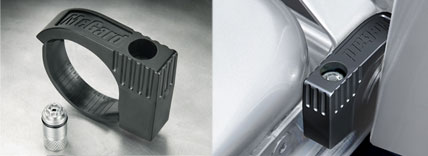
Do not extrapolate a fitment list to an unlisted model year or a special tailgate variant. Obtain confirmation from the manufacturer when the listing is incomplete. Keep any replacement-key information securely available outside the vehicle.
Aftermarket handle and power-lock options
A truck without the desired factory locking function may have compatible aftermarket options. The correct product needs to match the handle, linkage and, where applicable, electrical system. An accessory for another model or trim can look similar while operating differently.
Ask the supplier to identify the exact application and supported installation method. Where electrical work is involved, use a competent installer familiar with the vehicle. Improvised wiring, insecure connections or inappropriate routing can create reliability and safety problems beyond the tailgate.
After installation, test normal locking, unlocking and any camera or powered function affected by the work. An accessory should not require you to ignore a dashboard warning or disable a vehicle feature to make it usable.
A bed cover does not solve every security problem
A suitable tonneau cover or canopy may reduce casual visibility and access to contents. Different designs have different latches, materials and relationships with the tailgate. A soft cover and a rigid locking enclosure should not be treated as equivalent merely because both conceal the bed.
Check whether the cover depends on the tailgate being locked and whether all parts close in the intended sequence. The gate must still latch and operate normally. Do not force it against a poorly adjusted cover or accept a configuration that leaves an unintended gap.
For valuable tools, consider an appropriate secured storage arrangement within the vehicle. A hidden item can still be unsecured during travel, so theft protection and cargo restraint both need attention.
Tailgates can be heavy and may incorporate assist mechanisms, electrical connections and supported load-bearing functions. Do not weld, drill or clamp unidentified components based on a generic online shortcut.
Use the manufacturer’s permitted attachment points and instructions. A retention accessory should not damage a hinge sleeve, pinch wiring or change the gate’s alignment. If the gate must be removed for legitimate servicing, the authorized removal and reinstallation process should remain available.
For a rented, leased or financed vehicle, check the relevant permission and modification conditions before altering equipment. A cheap improvised fix can become an expensive ownership or warranty dispute.
Inspect the surrounding hardware
Check for visible damage, abnormal play, worn supports and a gate that does not sit evenly. Do not use a newly fitted lock to mask a structural or latch problem. A gate that opens unexpectedly during normal use creates a different and urgent concern.
Have damage assessed by a suitable vehicle professional. Replacement parts should match the vehicle’s actual configuration, especially where cameras, sensors or powered movement are involved.
Keep the area clean through the owner’s recommended maintenance routine. Dirt, corrosion or a trapped object can affect normal operation, but the right servicing product and procedure depend on the hardware.
Parking and visibility
Use appropriate authorized parking, preferably with useful visibility or controlled access where available. A secure garage can reduce exposure, provided its own doors and credentials are managed. Our garage-security guide covers those basics.
Parking close to a suitable barrier may restrict convenient access in some locations, but it must not damage the vehicle, block a walkway or prevent safe departure. Do not turn an anti-theft idea into an unsafe parking arrangement.
A camera can supply evidence, but a visible camera does not establish continuous supervision. Check the actual view of the truck, including nighttime glare and whether the relevant area is obscured by other vehicles.
Key and credential management
Keep truck keys, accessory keys and replacement-key details under controlled access. Do not leave an accessory key visibly in the cabin or permanently attached to the lock. At the same time, make sure a legitimate driver or service provider can obtain it when needed.
If a key or fob is lost, follow the vehicle manufacturer’s procedure and assess whether the missing credential can be associated with the truck. An independent hinge-lock key and the vehicle’s electronic keys may require different replacement or revocation arrangements.
For a business fleet, record who has access and include tailgate checks in the vehicle handover. Shared assumptions about which driver locked it can leave the gate unsecured for long periods.
Photographs, serials and insurance
Photograph the vehicle and tailgate, including distinctive features and installed accessories. Keep ownership, repair and accessory records somewhere accessible without the truck. Ask the dealer whether any identifying information should be recorded for a replacement component.
Check your policy’s treatment of stolen parts, aftermarket equipment and damage caused during theft. Do not assume comprehensive cover, a particular deductible or an accessory discount applies without checking the actual contract.
Keep the security-device model and installation record. An insurer may have specific requirements, and a general claim that a product is approved is not a substitute for the policy’s terms.
If the tailgate is missing or damaged
Report suspected theft through the appropriate police and insurer channels. Preserve relevant recordings and photographs without confronting a suspected thief or entering someone else’s property to recover a component.
Before driving, ask a qualified professional about exposed wiring, loose supports, lighting, cargo containment and other affected functions. Do not assume the truck is ready for ordinary use simply because the engine starts.
Replacement should restore the correct vehicle configuration. A used gate that physically attaches may still have incompatible electronics, uncertain ownership or missing safety-related parts. Use a reputable supplier and retain documentation.
Buying checklist for a tailgate accessory
| Check | Reason |
|---|---|
| Exact model year and tailgate variant | Prevents relying on a broad brand-name fit claim |
| Factory and aftermarket equipment already fitted | Identifies handle, camera and power-function conflicts |
| Purpose of the accessory | Separates locking closed from retention and cargo protection |
| Approved installation method | Avoids damaging hinges, wiring or the vehicle body |
| Authorized service and key recovery | Preserves maintenance access |
| Normal-operation test | Confirms the gate closes, locks and opens as intended |
The useful result is a compatible, maintained arrangement that fits your routine. There is no need to invent a list of four universal winners when fitment and vehicle configuration decide which products are even relevant.
Frequently asked questions
Does locking the cab also lock the tailgate?
It depends on the vehicle and equipment. Verify the owner’s instructions and test the actual gate rather than assuming the remote operates every lock.
Is a hinge lock the same as a tailgate handle lock?
No. A hinge-retention accessory and a lock controlling normal opening address different functions. Check whether your setup needs one, both or neither addition.
Can a universal accessory fit any pickup?
Do not rely on that word alone. Confirm the exact year, model and special tailgate options with the manufacturer.
Will a cover make the truck bed theft-proof?
No. Cover construction, latches, the tailgate and the whole vehicle remain relevant. Choose suitable storage and maintain normal vehicle security.


