Chain vs. Belt Garage Door Openers: Noise, Cost, Maintenance and the Right Fit
.sl-garage table{border-collapse:collapse;width:100%;margin:24px 0}.sl-garage th,.sl-garage td{border:1px solid #bdcbd0;padding:12px;text-align:left;vertical-align:top}.sl-garage th{background:#eef4f2}.sl-garage .table-scroll{overflow-x:auto}.sl-garage figure{max-width:760px;margin:28px auto}.sl-garage img{max-width:100%;height:auto;display:block;margin:auto}.sl-garage figcaption{font-size:14px;line-height:1.6;color:#425c63;padding-top:10px}.sl-garage .note{padding:20px;border-left:4px solid #27685d;background:#eff5f2;margin:24px 0}
A belt-drive opener is usually the better starting point when operating noise near living space matters; a chain-drive model can be good value where noise is less important. Neither choice is automatically stronger, safer or more secure. Those conclusions require the specifications of the complete opener and the condition of the door it will operate.
The mistake is comparing an old, vibrating chain unit with a new premium belt model and crediting the entire improvement to the belt. Motor control, mounting, rollers, door balance and the installation all change the experience. This guide separates those decisions so you can compare two actual quotations rather than buy a slogan.
What changes between chain and belt drive?
In a conventional overhead trolley opener, the motor drives a mechanism along a rail to move the door through its connecting arm. A chain-drive model uses a chain in that drive arrangement; a belt model uses the specified belt. Both still depend on an appropriate door, rail, motor unit and supporting installation.
Genie’s drive-type explanation identifies reduced metal-on-metal rail contact as a reason its belt systems operate quietly, while presenting chain drive as a comparatively economical design. That is a useful distinction, but it does not establish a universal decibel difference or service life for every brand.
| Decision | Chain drive | Belt drive |
|---|---|---|
| Noise-sensitive attached garage | Compare the actual motor and installation carefully | Often the more attractive starting option |
| Purchase price | Can offer a lower equipment cost | May cost more for otherwise similar equipment |
| Door capacity | Use the model’s stated limits | Use the model’s stated limits |
| Maintenance | Follow chain, rail and opener instructions | Follow belt, rail and opener instructions |
| Security and smart access | Depend on the complete product and accounts | Depend on the complete product and accounts |
| Best buying comparison | Equivalent supported door, accessories, installation and warranty | |
Use the table to narrow the shortlist, not to score every chain opener below every belt opener. A compatible, correctly fitted budget product can be a better purchase than a premium model that does not suit the opening.
First establish whether the door needs repair
An opener is not a replacement for the door’s counterbalance system. Springs and associated hardware help balance the door; the motor should not be selected to overpower a damaged or badly balanced assembly. A door that jerks, hangs unevenly or has damaged cables needs assessment before a new opener is installed.
Clopay explains the spring system’s role in supporting controlled movement. Its advice also identifies spring and cable work as hazardous for an untrained person. Have a competent door technician evaluate those components rather than adjusting spring tension as part of a shopping comparison.
Ask whether the quoted price includes correcting the door’s condition or assumes it is already sound. Otherwise, two apparently comparable opener prices may describe very different jobs. Replacing the motor while leaving the underlying resistance can preserve both noise and premature wear.
Judge noise where people will hear it
A garage beneath a bedroom presents a different problem from a detached building used during the day. Think about the time of use, nearby rooms and whether vibration travels into the structure. A quiet product demonstration on a supplier’s display is not necessarily representative of your building.
Genie’s opener buying guide notes that newer DC-motor chain systems with controlled starts and stops can be quieter than older chain equipment. Motor type and control therefore belong beside drive type in the comparison.
Also ask the installer to identify rattling door panels, worn rollers and unsuitable supports. A belt may reduce one source of noise while leaving the louder door hardware untouched. Do not apply improvised vibration pads that compromise the opener’s secure mounting.
Compare models, not just the names of the drives
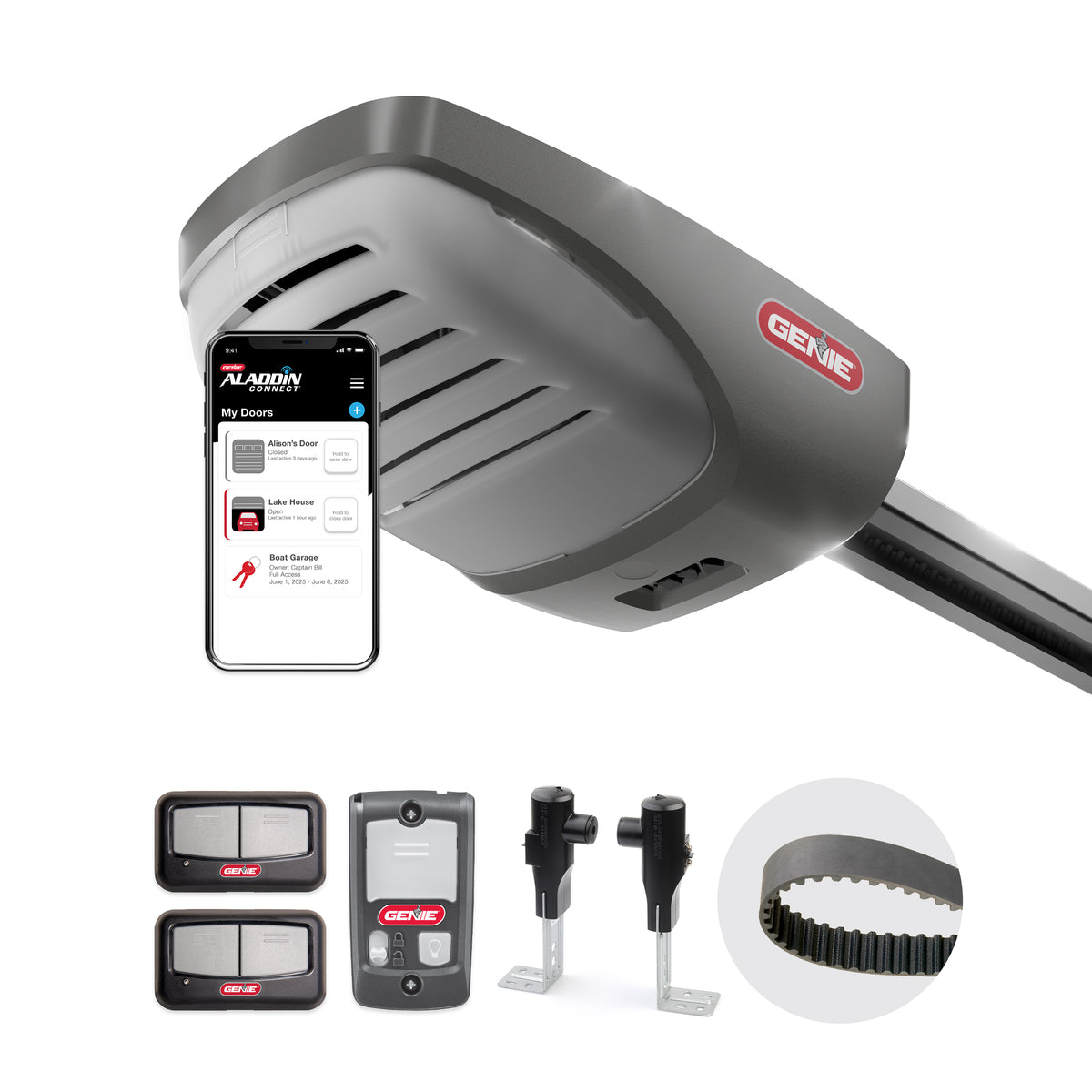
The pictured product’s documentation identifies a belt drive, DC motor and connected controls. A fair comparison would examine a chain model with the functions you actually need, rather than compare a fully equipped belt package with a bare replacement motor.
Record the exact model, rail, included remotes, wall control, safety equipment and any required door-height extension. Verify availability and support in your region. North American product examples are not universal installation specifications for every international door system.
Door size and capacity are model-specific
Check the door construction, dimensions, weight where required and permitted use. A manufacturer’s capacity statement assumes its installation conditions are met; it is not permission to operate a damaged door. Heavy insulated or oversized doors deserve an explicit compatibility assessment.
Motor horsepower or an equivalent-power label is not a complete comparison across different designs. Ask the supplier to confirm the exact opener is suitable for the actual door and expected use. A larger advertised number does not repair an unsuitable track or counterbalance arrangement.
Check the rail length too. A kit supplied for one standard height may need the manufacturer’s extension for a taller opening. Reusing an old rail or adding an unapproved section to save money can defeat the compatibility you paid to establish.
Maintenance: neither drive makes the door maintenance-free
Follow the selected opener’s instructions for inspection, lubrication and adjustment. A belt does not necessarily need the same treatment as a chain, and the door’s rollers, hinges and other components have their own requirements. Do not spray one general-purpose product over everything visible.
Arrange service when the drive becomes unusually noisy, travel changes or components appear damaged. Do not remove the opener cover, tension the drive or work near moving parts while it is energized. Power isolation may include a backup battery as well as the wall plug.
Keep the manual and part numbers. If a belt or chain eventually needs replacement, compatibility depends on the actual model and rail arrangement. A similar length or brand logo does not establish that a replacement assembly is correct.
Security comes from the whole access system
A drive-type upgrade does not by itself remove old remote controls, change a shared keypad PIN or secure the app owner account. Review those access methods when replacing an opener or moving into a property. Ask the installer which credentials are being retained and which are being replaced.
Likewise, a robust motor does not secure the garage’s pedestrian entrance or the connecting door into the house. Our garage-security guide covers those routes separately. Spend on the actual weak function instead of assuming a quieter drive is a burglary-resistance upgrade.
Use compatible manufacturer-approved locking arrangements. Do not engage a separate manual bolt while leaving an opener able to drive against it. An integrated automatic lock is a different device from a remote-control lockout setting.
Check smart features and backup power as separate options
Wi-Fi control, battery backup, lighting and additional remotes can appear on either drive type. Decide which functions matter before comparing packages. A smartphone icon does not tell you whether remote control needs an accessory, internet service or a separately priced integration.
Battery backup also has exact-model requirements. Ask whether it is included, optional at purchase or unavailable as a later retrofit. Do not select an opener on the promise that any battery can be added afterward.
Write down what should continue working when the internet fails and when mains power fails. Those are different events. Local radio entry, cloud access, lights and the door motor may not share the same dependencies.
Compare a complete installed price
Request the opener, correct rail, necessary extensions, controls, safety equipment, door preparation, installation and disposal as separate line items. Ask who provides warranty service and whether a fault visit attracts an additional charge. An impressive motor warranty may not cover every component or labor.
Here is a hypothetical comparison, not current pricing: a $250 chain package plus $200 installation totals $450. A $330 belt package with the same installation totals $530. An $80 difference may be attractive for a bedroom above the garage, but the calculation changes if one package needs a $60 extension that the other already includes.
The exercise is not to declare belt always worth $80. It shows why the relevant difference is between complete suitable quotations. Use local written quotes rather than treating a US example as an international installed-price estimate.
When keeping the existing opener makes sense
A sound supported opener may need a remote, compatible wall control or targeted service rather than wholesale replacement. Describe the actual complaint: excessive noise, unreliable access, unavailable features or a failed safety test. Each calls for a different decision.
When mechanical condition or safety functions are compromised, obtain a professional assessment. The US CPSC’s safety guidance emphasizes entrapment protection and testing according to the manufacturer. A cheap repair that leaves required protection unreliable is not good value.
Do not replace a chain with an arbitrary belt as a DIY conversion. Converting a complete approved arrangement can require different matched components; check whether the manufacturer supports it at all.
Three useful buying scenarios
Bedroom above an attached garage. Start with suitable belt-driven models, but include motor control and the door’s own noise in the quotation. Ask how the installer will address vibration and confirm useful quiet operation without compromising supports.
Detached garage with a modest budget. A supported chain-drive package may be entirely appropriate. Compare the full accessory list and reliable local access before spending on app features that will rarely be used.
Heavy or unusual door. Begin with the door technician’s compatibility assessment, not a drive preference. The right product is the one documented for that assembly and installed correctly, even when it differs from the popular option in a general buying list.
What to check before accepting the installation
Have the installer demonstrate ordinary travel, the manufacturer’s safety tests and every authorized control. Keep people, pets and vehicles out of the path, and do not test reversal with a person or body part. Unusual movement, grinding or a failed safety function needs correction before routine use.
Ask for the model and serial details, manual, warranty information and account handover. Agree who maintains the door and opener. The project should end with dependable everyday operation, not merely the first successful opening after the new motor is fitted.
Frequently asked questions
Is belt drive always quieter?
It can reduce drive-related noise, but the total result depends on the motor, door and mounting. Compare complete current models and correct existing mechanical noise.
Is chain drive stronger?
Not as a universal rule. Use the manufacturer’s door limits and intended duty, not the material name alone.
Does a belt opener improve security?
Drive type alone does not establish that. Access controls, compatible locking, door condition and account ownership remain separate checks.
Which would you choose?
For noise-sensitive living space, I would prioritize a suitable belt package; for an ordinary detached garage, I would compare the best-value compatible chain option. In either case, the door must be sound and the installation complete.