Wall-Mount vs. Ceiling-Mount Garage Door Openers: Fit, Space, Cost and Tradeoffs
.sl-garage table{border-collapse:collapse;width:100%;margin:24px 0}.sl-garage th,.sl-garage td{border:1px solid #bdcbd0;padding:12px;text-align:left;vertical-align:top}.sl-garage th{background:#eef4f2}.sl-garage .table-scroll{overflow-x:auto}.sl-garage figure{max-width:760px;margin:28px auto}.sl-garage img{max-width:100%;height:auto;display:block;margin:auto}.sl-garage figcaption{font-size:14px;line-height:1.6;color:#425c63;padding-top:10px}
A wall-mount opener can free the central ceiling area, but only when the door, shaft and available side space suit the exact model. An overhead trolley opener is often the simpler replacement where a compatible rail arrangement already exists. Neither mounting style is automatically the more secure or quieter complete installation.
Before buying a compact side-mounted unit, ask what is actually occupying the ceiling. Removing the opener rail does not remove the garage door’s tracks or the door panels when open. The useful comparison is between the space each finished installation leaves, not a product photograph showing an empty garage.
How the two layouts work
A conventional overhead unit operates the door through a trolley, rail and connecting arm. Belt and chain describe common drive arrangements within that layout. The motor is usually suspended toward the rear of the open door’s travel area.
A suitable wall-mounted residential opener operates from beside the door’s shaft rather than using that central trolley rail. It needs a compatible door and spring arrangement. The word jackshaft describes this different architecture; it is not simply an overhead opener turned sideways.
Our chain-versus-belt comparison addresses the drive choice for conventional trolley installations. Decide whether the building suits a wall-mounted arrangement before trying to compare it only on belt noise or horsepower labels.
Start with a compatibility survey
Have a competent installer identify the door type, spring system, shaft arrangement, tracks and condition. Ask for a written answer on whether the proposed wall unit fits without modifying the door. Photographs can help a supplier prepare, but they do not replace measurements and inspection.
The Genie 6172H-B product page, for example, specifies residential sectional-door applications and excludes several arrangements, including extension springs and one-piece doors. These exclusions belong to that product. They demonstrate why a general promise that wall units fit any garage is inadequate.
Do not modify springs, cables or the torsion shaft to make a discounted motor fit. Those components carry substantial stored energy. The manufacturer and a qualified door technician should resolve suitability before the order is placed.
The space comparison that actually matters
| Feature | Wall-mounted opener | Ceiling-mounted trolley opener |
|---|---|---|
| Central rail | Can eliminate the opener’s central trolley rail | Needs its specified rail and supporting arrangement |
| Space beside the door | Requires suitable shaft access, clearance and support | Usually places the motor farther back overhead |
| Door tracks and open panels | Still occupy space according to the door design | Still occupy space according to the door design |
| Electrical supply | May require a different outlet location | May reuse a suitable existing overhead supply |
| Conversion work | Can be substantial when the existing door does not suit it | Depends on the replacement opener and existing preparation |
Draw the proposed opener, door travel and any storage or vehicle lift on the same plan. A clean ceiling photograph does not establish that your car roof, rack or workshop equipment will clear the open door.
Wall space is not just a width measurement
Check the required space above, beside and around the shaft, along with access for fitting and servicing. Pipes, wiring, brackets and the door’s travel may obstruct an area that looks clear from floor level. The manufacturer’s installation dimensions are the starting point.
For comparison, the Genie 6072 documentation publishes clearance and outlet requirements for that model. Do not copy those measurements onto a different opener merely because both are called wall mount. Ask the installer to identify the exact manual used for the quotation.
Make sure the finished location remains serviceable. A battery or status indicator hidden behind fixed shelving may create unnecessary maintenance work even if the initial installation technically fits.
What a wall-mount package can include
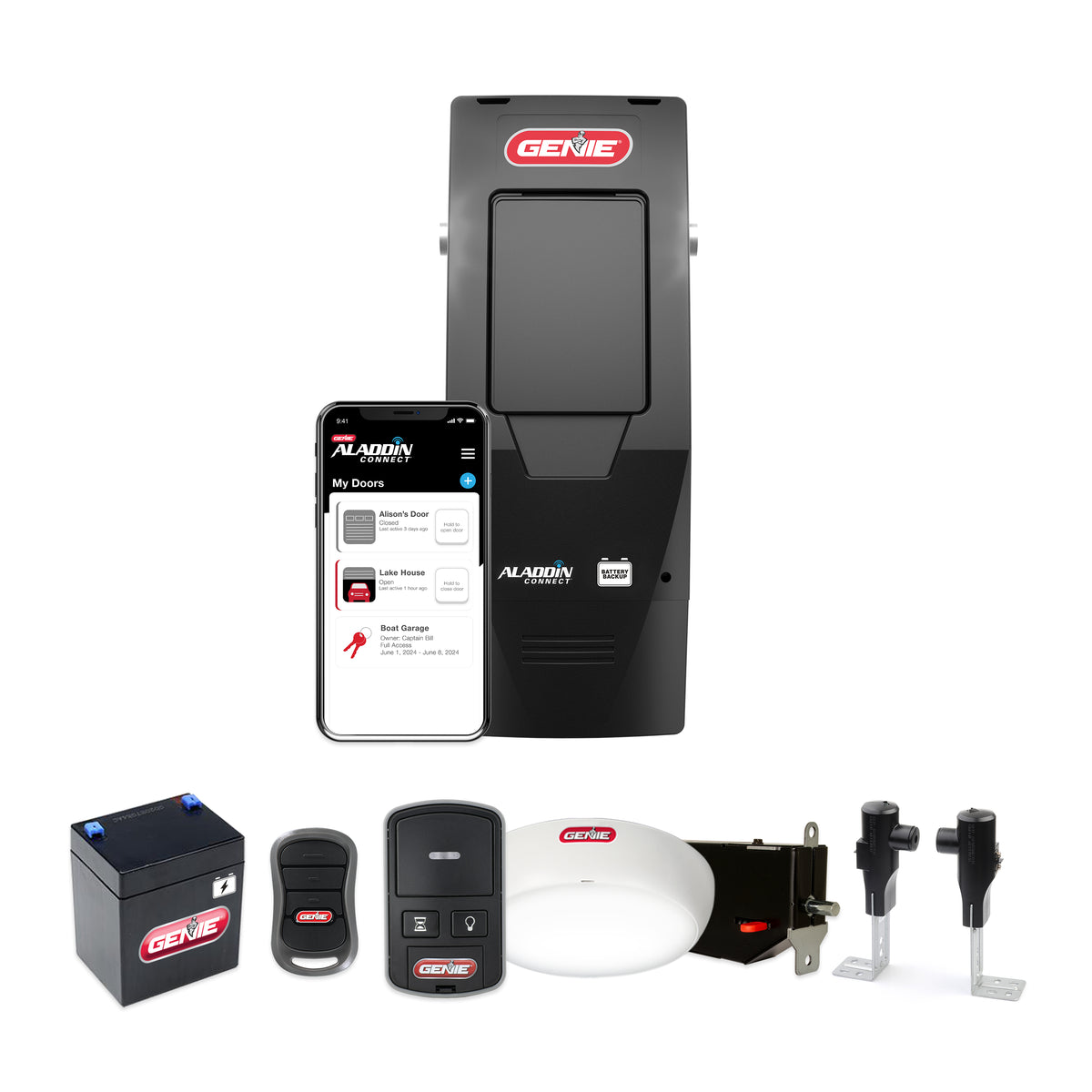
Compare the automatic lock, lighting, controls, battery and safety devices as part of the package. A quote that lists only the motor can omit components needed for the functions you expect. The installer should explain which items are included and which are separately supplied.
Keep photos as illustrations, not as evidence of independent testing. This guide compares documented layouts and ownership questions; it does not claim to have measured noise or forced-entry performance on the pictured product.
Noise can improve, but it does not disappear
Removing a central rail may alter how vibration is transmitted through the building. Motor design, wall attachment and the garage door itself still matter. A wall unit beside a bedroom wall should not be assumed silent simply because it no longer hangs under the bedroom floor.
Inspect rollers, tracks and panels before attributing every noise to the opener. A poorly balanced or damaged door can remain noisy with either drive. Clopay’s spring-system explanation shows why door balance is fundamental to controlled movement.
Ask what noise problem the proposed change is expected to solve. A quieter motor is a plausible improvement; guaranteeing that the entire garage becomes inaudible is not a useful installation specification.
Lighting can become a separate installation decision
Some overhead openers include lighting where people expect it, while wall-mounted systems may use a separate supported light. Consider whether that light reaches the room’s actual walking and working areas. One bright corner is not equivalent to a usable garage.
Some supported systems also connect a paired warning light with unattended operation. Chamberlain’s jackshaft diagnostic guidance identifies models where remote-light detection affects Timer-to-Close or app commands. It is an example of an accessory serving a functional role beyond ordinary illumination.
Do not omit required warning equipment because a different ceiling lamp already illuminates the space. Have the installer demonstrate the complete remote-closing behavior with the prescribed warnings and safety devices intact.
Door security remains an assembly question
An integrated lock on a compatible system can be useful, but it does not establish a universal security ranking between wall and overhead openers. The door panels, tracks, retention and side entrances still need attention. Nor does a new opener automatically remove previous digital users from an inherited account.
Review physical locks and operating sequences with the installer. A separate manual lock can damage the system if someone activates the motor against it. Never rely on remembering an undocumented special sequence when several family members have independent controls.
Our garage-security guide places the powered entrance alongside remotes, other access doors and the connection to the home. Those checks remain necessary after either type of replacement.
Compare installed cost in three parts
Separate equipment, building or electrical preparation, and door-system changes. A direct compatible replacement may involve mostly the first two. A proposed conversion can introduce more substantial work, and that work should be explicit before you approve the order.
For an illustrative quote exercise, imagine one option lists a $400 opener and $250 installation, while a wall-mount proposal lists $600 equipment, $250 fitting and $180 for a suitable outlet change. The totals are $650 and $1,030 before other applicable charges. These are hypothetical figures showing the calculation, not current local prices.
The extra $380 might be worthwhile if it solves a real space problem. It is wasted if the door tracks still block the intended storage or if an unquoted door conversion is needed. Compare the completed outcome, not only the difference between motor prices.
Battery backup and connected access are separate specifications
Confirm whether a battery is included and which functions remain available during a power outage. Local door operation, lighting and cloud connectivity may have different limits. An internet connection can also fail while mains power remains normal.
Keep a legitimate access method that does not depend entirely on the phone used during installation. The account should belong to the owner or responsible household, with appropriate invitations for other users. Retain the recovery process securely outside the garage.
Do not select a mounting style solely because one photographed package shows a smartphone. Smart and conventional variants can exist within the same product family, and service terms can change independently of the hardware.
When an overhead replacement is the sensible choice
A sound existing trolley arrangement with no genuine ceiling-space problem can be economical to replace with a suitable current unit. There is no requirement to convert simply because a wall-mounted product looks cleaner. Budget may be better spent on a damaged door, reliable backup or proper access management.
Check whether old brackets, rails and sensors can actually be retained. Reuse should follow the replacement manufacturer’s instructions, not the assumption that identical bolt holes establish compatibility. Ask the installer to show the allowed configuration.
The drive comparison helps choose between suitable overhead products. It is a narrower and often more useful decision than redesigning the whole garage.
When a wall-mounted design deserves serious consideration
It can be attractive where the door already suits the architecture and the central rail interferes with a planned use. A workshop, particular ceiling-storage arrangement or suitably designed high-lift door may benefit. The door and equipment clearances must be checked together.
Ask for a drawing or annotated photographs showing the final positions. Include the opener, power source, light, controls and door travel. A precise layout can prevent a vague promise about extra space becoming an argument after installation.
Do not proceed with an unsupported combination to avoid changing an attractive plan. A qualified installer should be able to explain incompatibility before any spring-system work begins.
What should be demonstrated at handover?
Observe ordinary opening and closing from the designated controls, the manufacturer’s required safety tests and any integrated lock sequence. Check lighting, position reporting and the supported outage procedure. Keep people and animals clear throughout.
Have the installer show the normal emergency-access arrangements without leaving anyone dependent on an unfamiliar mechanism. A heavy, damaged or unbalanced door must not be released casually from its opener. Repairs to the counterbalance system belong with trained personnel.
Keep the model numbers, installation instructions and warranty responsibility. A system that only the installer can operate through an undocumented sequence is not fully handed over.
Frequently asked questions
Will a wall opener fit any sectional garage door?
No. Shaft, spring, track, clearance and model-specific exclusions still matter. Obtain a proper compatibility assessment.
Does it remove all equipment from the ceiling?
It can remove the opener’s central rail, but the door’s tracks and open panels remain according to the door design. Check the complete layout.
Is wall mount more secure?
There is no universal ranking from mounting style alone. Compare the door assembly, compatible locking and control permissions.
Which option should I prioritize?
Keep the comparison focused on the problem you need to solve. Use a compatible overhead replacement for a straightforward job, and investigate wall mounting when its space benefits justify a verified installation.