

How to Replace a Deadbolt on a Prepared Door: Measurements, Installation and Testing
Replacing a deadbolt in an already prepared door can be a straightforward hardware job. The frustrating part is discovering halfway through that the new bolt has the wrong backset, the trim collides with the handle or the old strike never allowed the bolt to extend properly. Checking those details first is much easier than correcting them with the entrance dismantled.
This guide covers a compatible replacement in an existing, sound door preparation. It does not assume that every door can accept a bored deadbolt. For a door with no opening, use the new deadbolt preparation guide. For a metal or rated assembly, obtain the relevant manufacturer’s instructions before altering the door or frame.
Check that replacement is the right repair
Operate the old lock while the door is open, then compare normal closed operation. If the bolt moves smoothly only when open, note that before buying anything. A new cylinder will not necessarily solve a door that has sagged or a receiver that is misaligned.
Look for cracked timber, loose hardware and evidence of earlier oversized holes. Do not use the new trim to conceal structural damage. Where the existing preparation is sound and the replacement matches it, the project is much simpler than when door or frame repair is also required.
Keep an authorized alternative way in while testing. Do not remove the only working lock late in the day without confirming that the kit is complete and suitable.
Measure the existing preparation
The crossbore is the large opening through the door face. The edge bore connects it to the edge where the bolt emerges. Backset is the distance from the door edge to the crossbore’s center; it is not the distance from the edge to the nearest side of the hole.
Common North American residential products use 2-3/8-inch or 2-3/4-inch backsets, but a familiar dimension is not permission to skip the template. Check door thickness, permitted crossbore sizes and the clear space around both housings. Kwikset’s preparation guidance also distinguishes standard thicknesses from installations needing additional parts.
| Measure or inspect | Why it matters | Record before shopping |
|---|---|---|
| Door thickness | Determines mounting and connecting-component fit | Actual thickness at the lock |
| Backset | Positions the bolt relative to the housings | Edge to crossbore center |
| Crossbore | Determines housing and bracket compatibility | Diameter and condition |
| Edge preparation | Determines faceplate or supported drive-in arrangement | Shape, size and recess |
| Trim clearance | Prevents interference with handles or molding | Space on both sides |
| Strike opening | Must accept full bolt travel | Alignment, depth and supporting material |
Measure the actual door rather than the decorative trim around the old lock. A replacement’s larger interior housing may collide with a handle even though the central opening fits perfectly.
Lay out the kit and identify the screws
Before removing the original lock, compare the contents with the new product’s parts list. Separate the bolt assembly, outside cylinder housing, inside thumbturn, receiving strike, any reinforcement components and the supplied fasteners. Do not mix the new screws with a collection of leftovers on the workbench.
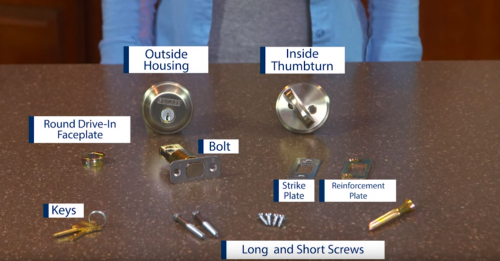
A hand screwdriver gives more control for many residential assembly steps. Schlage’s illustrated installation guide specifically cautions against stripping screws with a powered driver on the products it describes. That does not mean every preparation task is performed by hand; it means assembly torque and drilling are separate jobs.
Remove the old deadbolt with the door controlled
Keep the door open and stable. Retract the bolt and remove the interior cover or mounting fasteners according to the old product’s instructions. Support the exterior housing so it does not fall when the final connecting screw is released.
Remove the bolt assembly from the door edge and keep the old parts together. Do not pry aggressively against the painted surface or glass. If the hardware will not release normally, check for concealed fasteners or a model-specific cover rather than forcing it.
Photograph the exposed preparation and inspect it. Loose debris can be removed, but damaged support, unexpected wiring or a distorted opening calls for assessment before the new lock is fitted.
Set the new bolt’s backset and faceplate arrangement
Compare the bolt’s current length with the measured backset. Adjustable bolts use different methods to change configuration, so follow the exact instructions rather than pulling or twisting unfamiliar parts. A bolt should not need to be forced sideways to align with the door’s crossbore.
Some kits provide alternatives for a rectangular recessed faceplate or a round drive-in preparation. Use only the option supported by the lock and the actual door. Do not remove a plate simply because it appears to be extra packaging.
Check orientation marks and the required extended or retracted position for assembly. These details vary. A general installation article can explain the sequence, but it cannot supply the correct tailpiece position for every lock.
Fit the bolt without distorting the edge
Insert the correctly configured bolt in the existing preparation and check that the faceplate seats as intended. It should not rock on debris or project enough to interfere with closure. On a supported recessed installation, the recess needs to match the supplied plate rather than an unrelated old one.
Use the specified fasteners and tighten with control. If they will not hold, investigate the supporting material instead of driving a larger random screw into a damaged edge. If the faceplate needs substantial new cutting, reconsider whether the job is still a like-for-like replacement.
At this stage, look through the face opening and confirm that the bolt’s operating connection is positioned correctly. Correcting a simple configuration mismatch now is easier than after both housings are tightened.
Assemble the outside housing and inside thumbturn
Hold the exterior housing in its intended orientation and align its connecting component with the bolt according to the manual. The interior thumbturn must connect without forcing the parts into an unnatural position. Do not use the mounting screws to pull misaligned components together.
Start the connecting screws by hand so their threads engage properly. Tighten them evenly, checking operation as the assembly seats. A lock that works loose but binds whenever it is properly secured has an unresolved installation or compatibility problem.
Do not leave a housing loose to disguise that binding. Kwikset’s traditional-lock support and the exact kit instructions are better references for model-specific assembly than generic advice to loosen everything a quarter-turn.
Test the lock while the door is still open
Operate the inside control through its normal range, then test the outside key. The bolt should extend and retract consistently without excessive pressure. Confirm that the key behaves normally in its intended removal position.
If operation is stiff with the door open, the strike is not yet the explanation. Recheck bolt configuration, connecting-part orientation, thickness compatibility and assembly. Do not start cutting the frame to solve a lock that already binds independently.
For an electronic deadbolt, complete the manufacturer’s handing or calibration procedure at the specified stage. Do not assume a manual lock’s sequence applies unchanged to a motorized product.
Match the receiving hardware to full bolt travel
Inspect the old strike rather than automatically reusing it. The new lock may specify a different strike, box or reinforcement arrangement. The receiving opening needs enough room for the bolt’s full designed travel and suitable support behind the visible plate.
A shallow opening can make the lock appear to engage while stopping the bolt early. An oversized opening can conceal a badly positioned door. Neither is a reason to remove material indiscriminately. Use the new product’s preparation specification and investigate underlying alignment.
Our security strike-plate guide covers support, compatible fixings and the difference between a visible strike and a reinforcement plate. Long screws are not a universal remedy for every frame construction.
Close the door only after the open-door test passes
Retract the bolt, close the door normally and operate the inside control. Compare the effort with open-door operation. If the bolt rubs or stops, reopen and determine the contact point rather than repeatedly slamming the entrance.
The door should not need an unusual lift or pull to lock. Seals, hinges and the receiving hardware all affect this relationship. Use our closed-door alignment guide when the mechanism works freely but the installed entrance does not.
Once the inside test works, verify legitimate outside-key operation with a safe alternative access route available. Give each regular user a chance to try the new arrangement before declaring it finished.
Troubleshooting after replacement
| Symptom | Check first | Avoid |
|---|---|---|
| Thumbturn binds with door open | Assembly, backset and connecting-component alignment | Cutting the strike as a first response |
| Bolt binds only when closed | Door position and receiver fit | Forcing the key |
| Housing will not sit flat | Thickness, bracket and interference | Using screws to crush it into position |
| Screws do not hold | Correct fasteners and sound material | Hiding damage under larger trim |
| Motorized lock reports a jam | Mechanical travel and approved calibration | Repeated account resets before checking fit |
A replacement should improve normal operation, not create a secret maneuver that only the installer knows. If a basic compatible installation cannot be made reliable, obtain help before leaving the property dependent on it.
Keys, exit and handover
Decide whether you need the new lock keyed to other legitimate locks through an authorized service. Do not assume old keys will work simply because the brand is unchanged. Remove obsolete keys from the daily keyring once the change is verified.
Keep inside exit suitable for the occupants and applicable building requirements. An additional inside-key cylinder is not an automatic security improvement if it makes evacuation dependent on finding a key. Rated doors and managed buildings need the appropriate approval before hardware changes.
Record the model, installation date and any warranty information. Keep a legitimate spare accessible through a secure arrangement outside the locked interior, rather than hiding one in an obvious place beside the door.
When the job belongs with a locksmith or door specialist
Stop for significant frame damage, uncertain metal-door reinforcement, unexplained repeated binding, incompatible dimensions or a rated assembly whose modification limits are unclear. Professional help is also appropriate when the door’s safe exit function is affected.
Explain what you measured and whether the fault occurs open or closed. Those observations help distinguish a wrong part from an alignment problem. A useful quotation should state whether the work is lock replacement, preparation repair or broader door adjustment.
Frequently asked questions
Can I reuse the old strike plate?
Only when it is suitable for the new lock and the manufacturer’s installation requirements. Similar appearance does not establish identical fit or support.
Why does a new deadbolt feel stiff?
Check open-door operation first. Assembly or compatibility problems differ from a bolt that only binds against the closed frame.
Do I need a drill for a replacement?
A genuinely compatible prepared-door replacement may need mainly hand assembly tools. New or altered preparation is a different job and should follow the exact template and substrate requirements.
How do I know the replacement is complete?
Both authorized sides work smoothly, the bolt reaches full travel, the door closes normally and every relevant occupant can exit appropriately. A lock that merely looks fitted has not passed those checks.


