What Size Home Safe Do You Need? Measure Contents, Interior Space and Delivery Clearance
.sl-safe table{border-collapse:collapse;width:100%;margin:24px 0}.sl-safe th,.sl-safe td{border:1px solid #bccbd0;padding:12px;text-align:left;vertical-align:top}.sl-safe th{background:#edf3f1}.sl-safe .table-scroll{overflow-x:auto}.sl-safe figure{max-width:700px;margin:28px auto}.sl-safe img{display:block;max-width:100%;height:auto;margin:auto}.sl-safe figcaption{font-size:14px;line-height:1.6;color:#405b62;padding-top:10px}.sl-safe .note{padding:20px;border-left:4px solid #27685d;background:#f0f6f3;margin:24px 0}
The safe has enough capacity on the product page, yet your document folder will not pass through the opening without bending. Or it fits perfectly in the cupboard until the door swings out and hits the frame. These are measurement problems that a cubic-foot figure cannot answer.
Choose a home safe by the dimensions of your real contents, the usable opening and the space needed to operate and install it. Use the advertised volume to narrow the shortlist, then check fit in detail. A larger safe is not automatically better if it cannot be delivered, anchored appropriately or used comfortably.
Start with the items, not the size category
Gather the things you genuinely intend to store: folders, passports, jewelry cases, backup media and other permitted valuables. Keep sensitive information private while measuring. Include the container or protective sleeve you will actually use rather than measuring the bare item alone.
Separate items needed frequently from those accessed only occasionally. That changes the layout you need. A passport tucked underneath several heavy boxes technically fits, but it makes ordinary access inconvenient and increases the chance that belongings will be left outside afterward.
| Item or group | Measure | Question to resolve |
|---|---|---|
| Document folders | Outside height, width and loaded thickness | Will they lie flat or stand upright without bending? |
| Binders and archival boxes | Full depth, including handles or protruding fittings | Can they pass through the clear opening? |
| Jewelry cases | Closed dimensions and space needed to open them | Will shelves or drawers provide practical access? |
| Backup media | Cases and associated protective packaging | Is the safe’s protection suitable for that medium? |
| Future additions | Known or reasonably expected items | What extra compartment or shelf would actually be needed? |
Leave out items that need a different storage environment or rapid access elsewhere. The exercise is not to put every important possession into one box; it is to choose appropriate storage for defined contents.
Check the protection before optimizing the fit
A roomy security cabinet and a fire-rated document safe can have very different purposes. A container that accommodates your backup drive is not necessarily rated to protect its data in a fire. Likewise, a paper fire classification does not establish burglary resistance.
Use our safe-ratings guide to identify the actual protection category first. Then compare capacity among products that meet the requirement. Otherwise, the cheapest large cabinet can look like a bargain only because it has been asked to perform a job it was not specified to do.
This also explains why exterior size can be misleading. Insulation, door construction and other components occupy space between the outside dimensions and the usable interior. Do not estimate capacity from the footprint alone.
Three measurements that should appear in your shortlist
Record exterior dimensions, interior dimensions and the clear door opening. They answer different questions: where the safe can go, what fits inside and what can actually pass into it. Ask the seller for a drawing when the opening is not listed.
Check how depth is measured. Handles, hinges, keypad housings and rear projections may be excluded from a simple cabinet-depth figure. An alcove that matches the advertised depth exactly may not accommodate the installed product.
Also ask about shelves, trays and the lock housing behind the door. A nominal interior depth can be unavailable at the point where your largest folder needs it. The best evidence is a model-specific dimension drawing or a real fit check by the supplier.
Why equal volume does not mean equal usefulness
Consider two hypothetical empty interiors. One is 12 × 12 × 12 inches, and the other is 18 × 12 × 8 inches. Both enclose 1,728 cubic inches, or one cubic foot, before fittings. Their shapes nevertheless suit different objects.
The second can accommodate a flat item 14 inches long across its 18-inch dimension, provided the other measurements and opening permit it. The first cannot accommodate that length flat against a 12-inch side. A capacity label alone would make the two appear equivalent.
| Illustrative interior | Calculated volume | Practical difference |
|---|---|---|
| 12 × 12 × 12 inches | 1 cubic foot | More height than the second example, but no 18-inch side |
| 18 × 12 × 8 inches | 1 cubic foot | A wider, shallower compartment |
These are geometric examples, not specifications for actual products. A real safe adds an opening, door furniture and usable-clearance requirements that must be checked separately.
Use a product specification as a measurement exercise
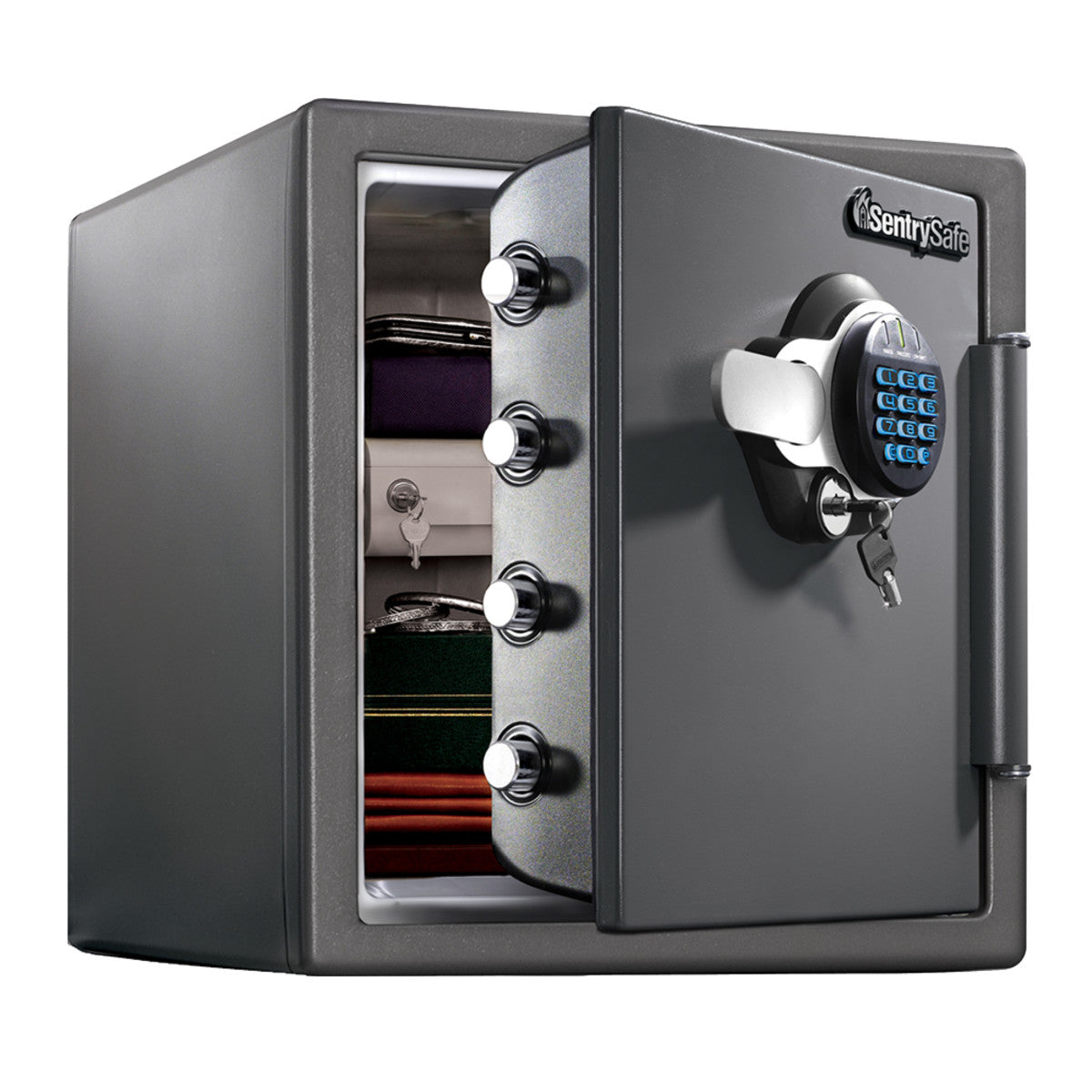
SentrySafe lists the SFW123GDC with an exterior approximately 17.8 inches high, 16.3 inches wide and 19.3 inches deep, compared with an interior 13.8 inches high, 12.6 inches wide and 11.9 inches deep. The difference illustrates why a photograph of a substantial cabinet does not establish room for a particular binder.
Use the manufacturer’s dimensions as the starting point and confirm the supplied configuration. Ask how the tray and shelf affect your intended arrangement and whether the quoted exterior measurements include every projection relevant to your space.
Do not assume another model with a similar name has the same interior. A different lock, capacity version or regional product can alter the specification. Keep the exact identifier with your comparison.
Paper size is not folder size
Measure the loaded folder or archival box rather than relying on the nominal paper format. Tabs, rings, protective sleeves and envelopes can add enough space to defeat a close fit. Decide whether the documents will lie flat or stand upright and measure in that orientation.
A folder squeezed diagonally into the safe may be difficult to retrieve without catching the door. Repeatedly folding documents to close the lid also defeats the purpose of orderly storage. If a flat arrangement matters, make that a requirement rather than an optional convenience.
The US National Archives’ family-records guidance recommends appropriate enclosures and storage conditions for records. A safe should accommodate that protective packaging rather than force you to discard it to gain a few millimeters.
Make a simple physical mock-up
Mark the proposed clear internal footprint on a clean surface using the dimensions supplied by the seller. Arrange your closed cases and folders within it without stacking beyond the usable height. Use cardboard to represent a shelf or door intrusion where the drawing identifies one.
Then mock up the clear opening separately. An object may fit in the interior once positioned but be difficult to insert through a smaller aperture. You should not need to force an important item through the opening or repeatedly remove all the shelves to use it.
This exercise checks geometry, not fire or burglary performance. It is particularly useful for an online purchase because the cost of returning a heavy installed safe can be quite different from returning an ordinary storage box.
Allow for growth without buying an empty room
List likely additions: another document folder, a larger jewelry case or an extra archival box. Include space to reach the items already stored. That gives a more useful allowance than automatically doubling the capacity for every household.
Compare the next size up only among models that still meet the protection and installation requirements. A larger unit may change weight, delivery cost, anchoring options and access to the chosen location. Its extra capacity should solve a foreseeable need.
For a collection that changes rapidly, modular shelves or removable trays can matter more than a small increase in nominal volume. Ask whether those fittings are supplied, adjustable or optional purchases.
Door swing and everyday access
Measure the space needed to open the door to the position required for drawers and trays. A cabinet door that opens partially may let you retrieve a passport but prevent a shelf from sliding out. A cupboard front or nearby wall can make an otherwise suitable safe awkward.
Consider the user too. A floor-level keypad may be uncomfortable to read, while an elevated heavy safe needs a properly assessed supporting arrangement. Do not place it on ordinary furniture simply to achieve a convenient operating height.
Try the proposed position with the person who will use it most often. The purchasing decision should not assume everyone has the same reach, eyesight or ability to move stacked contents.
Measure the delivery route before the final location
Start at the delivery entrance and follow the complete route: doorways, corridors, turns, thresholds, stairs and the final room. The safe and handling equipment need to negotiate the route, not merely fit through one doorway in a straight line.
Ask what delivery actually includes. Kerbside delivery, placement inside the building and installation at the final location are different services. Clarify stairs, difficult access, packaging removal and anchoring before accepting the quote.
Do not assume removing the door is an approved way to make a heavy safe manageable. Some models are not designed for that handling method. Let a competent installer choose suitable equipment and assess the route.
Weight needs a structural assessment where appropriate
The safe, contents and handling loads must be supported by the actual floor. A small footprint can concentrate weight, and an upper floor requires more consideration than checking whether a cupboard has enough width. A generic load limit from another building is not an assessment of yours.
Get appropriate advice when the weight or structure is uncertain. Do not treat a floor covering, furniture shelf or decorative plinth as a structural specification. Anchoring also needs a suitable substrate and permission where relevant.
Chubbsafes’ installation and certification guidance emphasizes correct fitting as part of the product’s intended protection. Ask your supplier how those requirements apply to the selected model instead of improvising after delivery.
Three different household examples
Mostly paper records. Begin with the protective folders and the verified fire requirement. Flat document fit and manageable retrieval may matter more than multiple tiny compartments. Keep appropriate copies elsewhere so one incident does not remove every record.
Frequently used jewelry. Measure the actual cases or fitted drawers, allow access without piling items together, and establish the required burglary protection and insurance acceptance. A convenient drawer layout does not replace those checks.
Records plus electronic backups. Separate the protection requirements instead of assuming one paper-safe label covers everything. An independent encrypted backup may address a different need from a physical container holding the original documents.
These are planning examples, not recommended universal capacities. The inventory and protection requirement determine the size; the number of people in the household alone does not.
What to include in a comparable quotation
Request the exact safe and lock option, usable interior dimensions, clear opening, supplied fittings and required door clearance. Include the delivery location, route constraints and installation scope. Ask the seller to identify any uncertainty before ordering.
Compare the complete installed price. A cheaper smaller safe may require a second purchase when the first folder does not fit, while a larger model may cost more to deliver than the product-price difference suggests.
The home-safe buying guide compares protection categories and example products. Use this measurement process alongside it, not as a replacement for checking the actual certification.
Frequently asked questions
Is a one-cubic-foot safe big enough for documents?
Sometimes, but the shape, opening and your actual folders decide. Measure the loaded documents and compare the usable dimensions rather than relying on volume alone.
Should I buy the largest safe I can afford?
Only when its capacity serves a real need and the installation remains suitable. Protection, delivery, access and supporting structure matter alongside storage space.
Can I use exterior dimensions to estimate the inside?
Not reliably. Walls, door construction and fittings occupy space, so obtain the model’s interior and opening measurements.
What is the most useful check before ordering online?
Mock up the usable interior and opening with your real contents, then confirm the delivery route and installation with the supplier. Those checks address different reasons a seemingly suitable safe can disappoint.