Home Safe vs. Bank Safe Deposit Box: Access, Insurance, Costs and What Goes Where
.sl-safe table{border-collapse:collapse;width:100%;margin:24px 0}.sl-safe th,.sl-safe td{border:1px solid #bccbd0;padding:12px;text-align:left;vertical-align:top}.sl-safe th{background:#edf3f1}.sl-safe .table-scroll{overflow-x:auto}.sl-safe figure{max-width:720px;margin:28px auto}.sl-safe img{display:block;max-width:100%;height:auto;margin:auto}.sl-safe figcaption{font-size:14px;line-height:1.6;color:#405b62;padding-top:10px}
Your passport is protected, but the branch is closed before an unexpected journey. Or every original document is conveniently at home, alongside the only backup of the household inventory. These are different failures of a storage plan: one concerns access, the other dependence on a single location.
A home safe and a bank safe deposit box can complement one another rather than compete for every item. Compare the actual protection, access process, insurance and cost, then decide where particular originals and copies belong. Banking and estate rules vary by country; the FDIC explanation below is specifically about the United States.
Compare functions before choosing a winner
A home safe gives you direct control over ordinary access, subject to having the credential and being able to reach the property safely. It also makes you responsible for the product, installation, maintenance and household permissions.
A bank box moves selected items to another location with the provider’s physical access process. It introduces branch hours, identification requirements, rental terms and procedures for additional users or exceptional access. Those conditions should be read before you put something important inside.
| Question | Home safe | Bank safe deposit box |
|---|---|---|
| How do I retrieve an item? | Through your authorized lock and accessible property | Through the provider’s hours and access procedure |
| What protection is specified? | The actual safe’s ratings and installation | The provider’s facility, contract and relevant arrangements |
| Who manages access? | You or the responsible household/business owner | Named authorized users under the provider’s process |
| What does it cost? | Purchase, delivery, installation and upkeep | Rental and applicable access, key or other charges |
| Is there insurance? | Only what the actual policy or guarantee provides | Do not assume contents are covered merely because the provider is a bank |
| Does it separate items from the home? | No, unless installed at a different property | Yes, though regional events can affect both locations |
The better choice can differ for a frequently used document and a rarely accessed original. One broad label such as safest storage is not enough to make that decision.
US readers: FDIC insurance does not cover box contents
The FDIC’s deposit-insurance guidance lists safe deposit contents among the things it does not insure. The money in an eligible deposit account and physical cash stored in a rented box are different arrangements.
This does not establish whether a particular provider or private insurance policy supplies other protection. Ask the bank about its contractual responsibilities and ask your insurer about coverage for the actual items and location. Keep the answers in writing.
Outside the United States, check the relevant deposit-protection scheme and provider contract. Do not transfer the FDIC terminology or assume a local bank’s account protection automatically includes valuables in its vault.
A home safe also needs a precise insurance check
A manufacturer rating and an insurance policy answer different questions. A safe may have a documented burglary grade while your policy imposes additional requirements for a particular collection, amount or installation.
Ask whether specified items must be declared, whether valuation records are needed and what installation evidence is required. Do not treat a retailer’s suggested cash rating as a universal coverage limit.
Use the safe-ratings guide to understand the product evidence before discussing it with the insurer. Fire, burglary and water claims should remain separate rather than being combined into a vague promise that everything is insured.
Access is the strongest reason not to store everything off-site
Before using a bank box, ask about normal opening hours, appointments, identification and exceptional closures. Check the process for a lost key or an authorized user who cannot attend. Do not assume every branch offers the same service or that boxes remain available indefinitely.
Make a list of items you might need outside those hours. A document that can wait a week is different from one needed before immediate travel or during a household disruption. Decide using the actual schedule and your needs, not a general statement that banks are open often enough.
The FTC’s document-preparation guidance distinguishes rarely used originals from accessible records and emergency information. The useful principle is to plan retrieval before an incident, not to discover the access restriction while already under pressure.
Do not confuse a portable document chest with a burglary safe
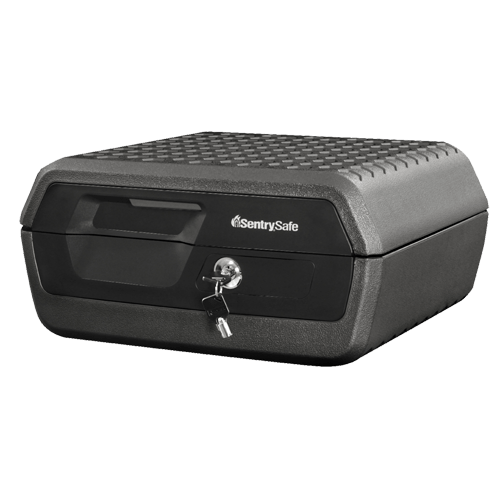
For example, SentrySafe describes the CHW30220’s key lock as basic privacy protection and says it is not intended for tool attacks. That does not make it useless; it means the buyer should evaluate its documented document-protection role rather than assume it provides every function of a different safe category.
A home-storage plan should match the items and threat. The home-safe guide and document-bag comparison explain why one inexpensive container should not be asked to replace a complete protection plan.
Decide by item rather than by a single favorite location
| Item | Key decision | Practical planning approach |
|---|---|---|
| Passport or frequently used original | How quickly must you retrieve it? | Balance suitable protection with realistic access hours |
| Hard-to-replace records rarely needed | Can ordinary retrieval wait? | Consider appropriate off-site storage and secure reference copies |
| Emergency contacts and policy details | Will you need them away from home? | Keep an accessible protected copy independent of one locked location |
| Jewelry or collectibles | Use frequency, valuation and policy conditions | Discuss the actual items, not a generic coverage assumption |
| Digital backups | Media conditions, encryption and restoration | Maintain independent copies and verify access |
| Estate and authority documents | Who must obtain them, and under which rules? | Agree an appropriate plan with the provider and local professional adviser |
This table is a decision aid, not a legal instruction for every document. Requirements for originals, certified copies and authorized access vary with the organization and jurisdiction involved.
Do not assume that the person who needs an original after your death or incapacity can simply enter the box. Ask the provider about its process and get appropriate local legal advice on where the original should be held and who needs access.
The FTC advises discussing the original will with the attorney as part of document preparation. That US guidance is not a universal rule about every country’s estate procedure, but it highlights a real planning question: avoid putting the only authority document behind an access process that has not been resolved.
Keep the existence of the box and the responsible provider recorded privately where the appropriate person can find it. A perfectly protected original is of limited use when nobody knows where it is or how to request it.
Keeping an independent copy away from home can reduce dependence on one building. It does not make the second location invulnerable or guarantee access during a regional emergency. Consider how the two locations and communication arrangements might be affected together.
FDIC disaster-preparation guidance recommends maintaining important records and considering secure off-site copies. A practical household plan can combine accessible information with protected originals rather than placing every copy inside the same safe.
Do not leave sensitive scans in an openly shared cloud folder simply to achieve an off-site copy. Security and retrievability both matter; an independent copy should remain under appropriate account and access controls.
Protect the contents from environmental damage
Physical security is not the only question at either location. Ask about the provider’s terms and care advice, and package sensitive documents appropriately. A bank box should not be assumed to control every material’s humidity or temperature requirements.
At home, select a safe and location suited to the contents, and follow the manufacturer’s maintenance instructions. The moisture guide explains why a closed water-resistant enclosure does not automatically maintain a dry interior.
Keep valuable photographs and documents in appropriate enclosures rather than loose against metal or crowded into a tight space. For irreplaceable collections, specialist preservation advice may matter as much as the choice between two locations.
Compare costs using the full period of ownership
Home storage can include purchase, delivery, installation, maintenance and later relocation. Bank storage can include annual rent and charges identified in the actual contract. Insurance costs and conditions should be considered separately where relevant.
Here is an illustration using invented figures, not current market quotations. A home safe costing $400, with $180 installation and $20 per year of maintenance allowance, totals $680 over five years. A box at $90 annually plus a hypothetical $50 setup charge totals $500 over the same period.
| Illustrative option | Calculation | Five-year total |
|---|---|---|
| Home safe | $400 + $180 + (5 × $20) | $680 |
| Bank box | (5 × $90) + $50 | $500 |
The arithmetic does not establish equivalent capacity, access or protection. Replace the assumptions with real quotes, and include only fees that actually apply. A cheaper total is not automatically the better choice when it removes access you need.
Read the bank’s agreement before filling the box
Ask about permitted contents, additional authorized users, identification, missed payments, lost keys, branch changes and termination. Review liability provisions and any separate insurance offer rather than relying on a verbal description of vault security.
Record the provider and box reference in a secure location. Keep contact information current so notices reach you. If the branch changes or the account becomes inactive, use the bank’s official process rather than waiting until you urgently need an item.
A private vault provider is another possible service category, but do not assume it has the same regulation, contract or protection as a bank. Compare its actual arrangements independently.
Maintain an inventory without exposing the valuables
Keep a private list of what is stored where, with relevant photographs, valuations or receipt references. Update it when contents move. Do not include access credentials in a casual inventory shared with unrelated people.
For important documents, note whether the stored item is an original, a certified copy or a reference copy. That distinction can save time when an institution later requests a particular form.
The identity-protection guide explains how document copies and controlling accounts should be protected. Organizing records should not create a new unprotected archive of personal identifiers.
A home safe needs a legitimate key or combination recovery plan. A bank box has its own verification and access process. Keep the relevant support details outside the storage location that might become inaccessible.
For home equipment, use the safe recovery guide rather than improvised entry methods. For a bank box, contact the provider about its actual replacement or access procedure and applicable charges.
Do not promise another household member access based only on handing them a key. The provider may require separate authorization, and local rules can affect access following death or incapacity.
A layered arrangement can be the practical answer
One household might keep frequently needed originals in an appropriately installed home safe, rarely used records in an accepted off-site arrangement, and protected reference copies available through a separate secure account. Another may need only a modest document plan and no bank box at all.
Choose based on the actual contents, access requirements and consequences of loss. Avoid buying a large safe simply because an annual rental feels wasteful, or renting a box that makes every routine document request inconvenient.
Review the plan after a move, marriage, change of executor, bank change or other relevant event. The hardware can remain unchanged while the people who need legitimate access change completely.
Frequently asked questions
Are safe deposit box contents FDIC insured?
No. In the United States, the FDIC does not insure the contents of a safe deposit box. Ask about any separate contractual or private insurance protection.
Is a bank box always safer than a home safe?
There is no useful universal answer without specifying the contents, provider, home-safe rating, installation and access needs. Compare the real arrangements rather than the labels.
Should I keep my passport at the bank?
Consider how quickly you may need it and the actual access process. A document needed unexpectedly should not be placed somewhere whose availability you have not planned for.
Does a digital copy replace every original?
No. Copies can support recovery and reference, but institutions and legal processes may require originals or particular certified versions. Confirm the requirement for the document involved.