Electronic vs. Mechanical Safe Locks: Reliability, Access and the Right Choice
.sl-safe table{border-collapse:collapse;width:100%;margin:24px 0}.sl-safe th,.sl-safe td{border:1px solid #bccbd0;padding:12px;text-align:left;vertical-align:top}.sl-safe th{background:#edf3f1}.sl-safe .table-scroll{overflow-x:auto}.sl-safe figure{max-width:700px;margin:28px auto}.sl-safe img{display:block;max-width:100%;height:auto;margin:auto}.sl-safe figcaption{font-size:14px;line-height:1.6;color:#405b62;padding-top:10px}
A mechanical dial removes the need to maintain a battery, but it does not remove the need to operate the lock correctly or keep a recoverable combination. An electronic keypad can make frequent access easier, but a screen and a beep do not prove that the complete safe is well protected. Both choices need to be judged as actual products, not stereotypes.
Choose electronic access when its usability or supported user-management features solve a real need; choose a mechanical dial when battery-independent operation and its particular routine suit you. In either case, verify the exact lock, the safe’s certification and the legitimate recovery process before purchase.
The comparison at a glance
| Decision | Electronic keypad | Mechanical combination dial |
|---|---|---|
| Ordinary access | Usually a code-entry sequence with model-specific feedback | A defined dialing sequence requiring appropriate alignment and direction |
| Power | Needs its specified battery or power arrangement | A conventional mechanical dial operates without a battery |
| Multiple users | Separate codes may be supported on particular models | Commonly a shared combination unless another arrangement is specified |
| Changing access | Depends on authorized programming functions | May require a trained technician or a particular supported procedure |
| Service | Electronics, power connections and mechanical integration | Mechanical components and correct dial operation |
| Protection evidence | Check the exact lock and complete-safe classifications | Check the exact lock and complete-safe classifications |
These are useful tendencies, not a feature list for every product. A basic household keypad and a commercial multi-user lock can have very different functions even though both accept numbers.
Do not confuse the lock rating with the safe rating
The lock controls the mechanism, but the body, door and installation remain part of the protection. A certified lock fitted to a lightly constructed cabinet does not automatically give the cabinet a high burglary classification.
UL’s anti-theft certification overview distinguishes lock standards from the standards for safes and residential security containers. Ask which evidence applies to the complete product rather than accepting the general statement UL lock as an answer to every security question.
Our ratings guide explains these categories and their limits. Compare the same safe body with its approved lock options where possible; otherwise you may attribute a construction difference to the keypad or dial.
Mechanical locks: a predictable routine without battery changes
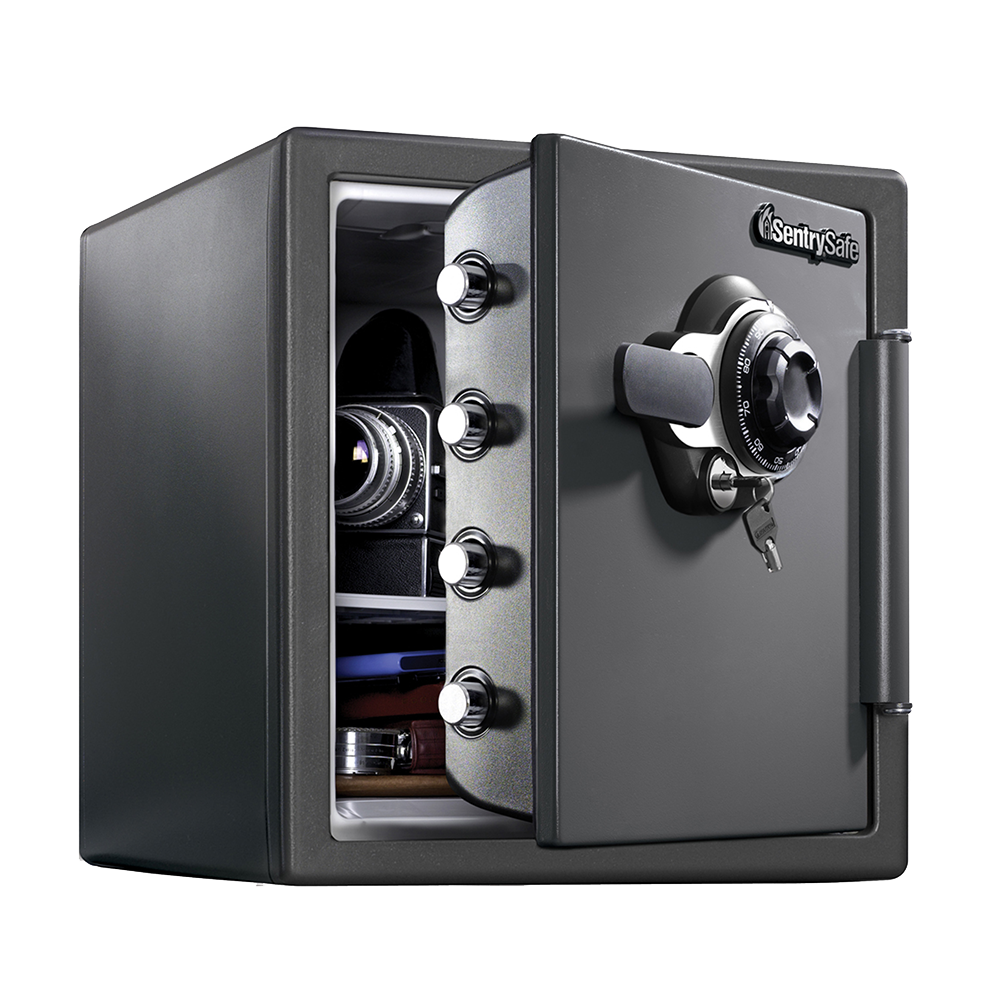
A conventional mechanical combination lock can be attractive when the owner prefers a physical dialing process and wants to avoid battery maintenance. It still needs correct use, appropriate servicing and an accessible authorized record of the combination.
Different mechanical models have different operating instructions and supported combination-change methods. Do not assume a sequence learned on one safe applies to another or that all dials can be reprogrammed by the owner.
For example, Sargent & Greenleaf’s 6730-family documentation identifies particular Group 2 mechanical locks and a key-changeable design. That is a property of those models, not permission to change every household dial through a generic procedure.
Electronic locks: convenient access, but features need verification
A keypad can simplify frequent openings and may be easier for users who struggle with precise dial movement. Some electronic models support separate users, manager functions, time delays or audit information. Others offer only a single owner code.
Sargent & Greenleaf’s safe-lock range lists products with different oversight and access functions. Use that as a reminder to select a specific feature set, not to assume that every electronic lock records who opened it.
For a household, extra administration may be unnecessary. For a small business, named user access can be valuable when staff change, provided someone actually manages it. Buying the feature without assigning responsibility does not create an effective access policy.
Try the controls before deciding
A showroom demonstration can reveal a usability problem that a specification sheet misses. Ask the intended user to operate the lock normally with the safe in a position resembling the installation. Check legibility, reach and the effort required without being rushed.
Consider whether the keypad has usable tactile or visual feedback and whether a dial’s markings are comfortable to read. Bright showroom lighting and a demonstrator’s experience can make a process look easier than it will be in a low cupboard at home.
Do not choose solely by the fewest seconds shown in a promotional video. The more useful test is whether the authorized user can operate the system consistently and close it correctly afterward.
Battery location matters more than many buyers expect
Before purchasing an electronic safe, ask where the normal battery compartment is and what the official procedure is when the battery is depleted with the door closed. Some models use an external compartment; others provide a documented auxiliary power arrangement.
Temporary external power, where supported, usually restores the normal authorized operating path rather than replacing the required code. It should not be marketed as a way for anyone to open the safe without credentials.
SECURAM’s ProLogic battery guidance, for example, describes model-specific external battery access and low-battery behavior. Other families can differ, so check the actual instructions and avoid forcing a keypad off the door based on a video about another product.
Use the battery specified for the actual lock
Do not make a brand-wide assumption from advice for a neighboring model. Battery chemistry, size and connections must match the instructions. Replacing only one weak cell in a multi-cell set or mixing old and new batteries can also conflict with the manufacturer’s guidance.
SentrySafe’s battery page separates several lock families and includes exceptions to its general alkaline-battery guidance. That is why the correct question is what this lock requires, not which battery an online commenter prefers.
Keep a reasonable maintenance reminder and act on the documented low-power warning. A mechanical lock removes this battery task, but it still needs an access and service plan of its own.
Does battery loss erase the code?
Check the model’s documented behavior rather than assuming either that every code disappears or that every configuration is retained indefinitely. Routine battery replacement and a factory reset are different operations. Do not start pressing hidden buttons merely because the keypad is quiet.
For a purchase, have the seller demonstrate the authorized maintenance process or point you to the exact manual. For an existing fault, preserve the current settings and contact the safe or lock maker when the recovery route is unclear.
The important preparation is knowing how legitimate access is restored. It is not learning an improvised sequence that might damage the lock or leave a changed code untested.
Changing combinations and removing access
On a supported electronic lock, changing or removing an individual code can be useful when a temporary user’s role ends. Confirm whether the product actually allows separate credentials and which account has authority to manage them.
A shared mechanical combination may need to be changed when it has been distributed too widely. Depending on the lock, that can require an approved change key, trained technician or another manufacturer-specific process. Do not assume that owning the safe makes every internal adjustment a suitable DIY task.
Whichever system you choose, keep a private access record without storing the code in an obvious note beside the safe. For a business, connect the process with your staff access and departure procedures.
Recovery keys are not all the same
A key may open a simple lockbox, provide a supported alternative on one electronic design, or add a separate locking condition on another. Its function must be established from the manual. The presence of a keyhole is not proof that the combination can be ignored.
SentrySafe’s dual-key explanation states that the key on relevant SF and SFW models is an additional locking layer, not a general replacement for the combination. Keep that distinction when comparing product listings that casually label every key as backup.
Ask how lost credentials are handled, what proof of authority is required and which organization provides support. A replacement key in a drawer is useful only when it actually performs the role you expect.
Reliability depends on more than electronics versus mechanics
Either type can become difficult to use when installation, boltwork or the door is faulty. A keypad may accept a valid code while the mechanism remains under pressure, and a dial may be blamed for a door that has shifted. Diagnose the observed behavior before replacing the lock category.
Product quality, maintenance, environment and supported service all affect the ownership experience. Without comparable test data, avoid claims that electronic locks always fail after a certain number of years or that a mechanical dial never needs attention.
Check the supplier’s service capability and the availability of appropriate parts. A low purchase price can be less attractive when a failure leaves you without an accountable recovery route.
Changing the lock on an existing safe
A retrofit must suit the safe, boltwork and the required certification. A lock with a familiar mounting footprint is not automatically approved for every cabinet. Obtain confirmation from the safe maker or a competent safe technician before ordering.
Ask whether the conversion preserves the relevant certification and any insurance acceptance. Keep the installed model and service record. Do not attempt internal alterations to make an incompatible mechanism fit.
The rating explanation helps distinguish the lock’s own listing from the complete safe’s status. That distinction remains important even when the replacement is more expensive or has more features.
Which would suit common users?
A household opening the safe several times a week. A clear, supported keypad can be convenient if battery maintenance and recovery are straightforward. Test the controls and do not pay for business features you will never manage.
An owner who prefers occasional battery-free access. A suitable mechanical dial may be appealing when its sequence and service requirements are understood. Keep the authorized combination record recoverable without leaving it exposed.
A small business with changing staff access. Consider a model that genuinely supports separate users and the required oversight. A basic keypad with one shared code is not the same as a managed access system.
These examples are selection criteria, not universal winners. The safe’s protection and installation still need to meet the actual purpose.
A buying and handover checklist
| Confirm | Keep with your private records |
|---|---|
| Exact lock and safe configuration | Model identifiers and applicable certification |
| Normal operating sequence | Official manual and a successful authorized demonstration |
| Power maintenance, where relevant | Correct battery specification and approved access method |
| User and code management | Who has authority and how access changes |
| Recovery and service | Manufacturer, installer and ownership-verification route |
| Installation | Confirmation that the safe is fitted and operates correctly |
Keep the manual accessible outside the safe and credentials in a suitable secure record. A support document locked inside the unit is least useful when you need it most.
Frequently asked questions
Are mechanical locks always more secure?
No. Compare the exact certified lock and complete safe rather than assigning one resistance level to every mechanism with a dial or keypad.
Does an electronic safe need Wi-Fi?
Not inherently. Many keypads are local devices; connectivity is a separate feature that must be checked for the actual model.
Is a fingerprint reader a replacement for recovery planning?
No. Understand the supported backup and owner-verification process, as well as the complete safe’s protection. A convenient authentication method does not resolve every failure.
What matters most before buying?
Verify that the intended users can operate it, that the protection meets the requirement and that legitimate maintenance and recovery are documented. Those checks are more useful than a blanket claim that old or new technology always wins.