Rekey or Replace Your Locks? Costs, Lost Keys and When an Upgrade Makes Sense
You have just moved into a house and the front deadbolt works perfectly. The uncertainty is who still has a key. Replacing a healthy lock can solve that access problem, but it may involve buying hardware you do not need. Rekeying a suitable existing cylinder can change which key operates it while preserving the rest of the installation.
Rekey a compatible, sound lock when the main goal is to invalidate old keys. Replace or repair hardware when condition, compatibility or a different security requirement makes the existing assembly unsuitable. Replacing only a cylinder is also possible on some designs. The sensible decision begins with identifying the problem, not treating every request to change the locks as the same job.
Rekeying, cylinder replacement and full replacement
Rekeying changes the keying of the existing mechanism so the former operating keys no longer work as intended. In a common pin-tumbler cylinder, a locksmith changes internal components to match the authorized new key. Other mechanisms use their own approved processes.
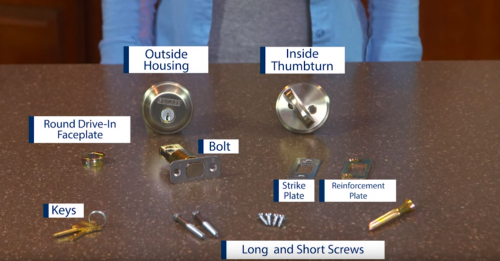
Cylinder replacement changes the key-operated component while potentially retaining the handle, lock case and other parts. Full lock replacement changes a larger assembly, such as a complete bored deadbolt or lockset. A quote saying new lock is too vague to tell you which work is included.
| Work | What changes | Best reason to consider it |
|---|---|---|
| Rekeying | Which key operates a compatible existing cylinder | Unknown or unwanted old keys, with sound hardware |
| Cylinder replacement | The key-operated component | Worn cylinder, different keying or a suitable cylinder upgrade |
| Complete lock replacement | The specified lock assembly | Damage, unsupported parts or a different function |
| Door or frame repair | The supporting entrance and alignment | A lock that cannot engage properly in the closed position |
| Electronic access changes | Codes, users, credentials or account permissions | Unwanted digital access, independently of physical keys |
More than one row may apply. A damaged door may need repair and a new keying arrangement. A smart lock may need its cylinder rekeyed and an old user’s app invitation removed. Naming the separate tasks makes the quotation and final test clearer.
Ask what was actually changed at handover. Receiving two keys does not establish that no copies exist. A seller saying the locks are new also does not tell you who held keys during installation or renovation.
Make a list of exterior locks, outbuildings and other relevant access points. Then ask an accountable locksmith which compatible cylinders can be rekeyed and which need different work. There is no reason to replace a healthy handle merely to change the key if the existing system supports a suitable service.
For an apartment or managed building, get the required permission and preserve legitimate shared-access arrangements. Do not change a communal cylinder or a rated entrance independently. Our apartment security guide explains the responsibilities around those decisions.
Lost keys: a new copy does not invalidate the missing one
Replacing a missing key gives you another way to operate the same lock. It does not stop the original from working. If the key may be associated with the property or held by someone who should no longer have access, discuss changing the authorized keying rather than merely ordering another copy.
The absence of the original key does not automatically prove that the entire lock must be replaced. A qualified locksmith can assess legitimate service options for the particular mechanism and current access state. The work and cost may differ from an ordinary in-shop rekey with a working key.
Be prepared to show authority over the property. A proper access-verification process is part of responsible locksmith work. If the immediate problem is being locked out, our lockout guide covers safe next steps without damaging the entrance unnecessarily.
A stiff lock may need repair, not a new key arrangement
Notice whether the key or thumbturn is difficult with the door open as well as closed, where safe testing is possible. A mechanism that works freely open but binds shut may be affected by the door-to-frame alignment. Rekeying does not correct a bolt hitting the receiver.
Look for uneven gaps, loose hinges, a displaced seal or a door that needs lifting to secure. Do not start filing a strike or replacing every screw without identifying the construction. A new lock may struggle against the same unresolved obstruction.
Use our closed-door diagnosis guide and key-not-turning guide to describe the symptom accurately. The most economical solution can be an alignment repair followed by rekeying if key control is also uncertain.
Rekeying does not upgrade every security property
If the current hardware is otherwise unchanged, rekeying is primarily an access-control change. It should not be marketed as transforming weak construction, damaged framing or an unsuitable cylinder into a higher-rated entrance.
When the objective is stronger hardware, compare the exact replacement and its documented performance. Check the receiving strike, frame and hinge support as well. A high-quality cylinder is still only one component in the complete doorway.
Our door-reinforcement guide considers the whole assembly. It is the more useful next step when the concern is physical weakness rather than who holds a key.
Can several doors use one key?
Sometimes, if the cylinders and desired keying are compatible. Matching the finish or buying the same broad brand does not establish that every existing mechanism accepts the same key system. Have the locksmith inspect the actual cylinders and any restricted or managed key requirements.
Schlage’s keyed-alike guidance describes ordering options and matching suitable new locks to existing Schlage keys. Its mechanical-box matching process is not a universal rule for every electronic product or another manufacturer’s cylinders.
One key is convenient, but consider the access consequence. A contractor needing a shed does not necessarily need a key operating the whole home. Decide the intended access groups before optimizing the keyring purely for convenience.
Cylinder-only replacement on a multipoint door
On some uPVC, composite or other doors, a suitable replacement cylinder can change key control or cylinder performance without replacing the entire multipoint mechanism. Its size, inside/outside proportions and operating features need to match the door and protective furniture.
A new cylinder will not repair a failed gearbox, misaligned locking points or damaged frame. Ask the installer to identify which component is worn. Conversely, a sound multipoint strip should not be replaced automatically because the cylinder needs attention.
Our uPVC door guide explains these components. Preserve required inside exit and appropriate outside backup operation, especially where a retrofit motor or inside key is involved.
Smart locks have two access inventories
A smart deadbolt with a mechanical key can require both physical and digital changes. Removing a phone invitation does not usually invalidate an existing metal key. Rekeying the cylinder does not necessarily remove a former resident’s code, app account or automation.
Review every supported method through the manufacturer’s authorized process. Check owner-account transfer, recovery details, named users, keypads and linked services. Do not assume a factory reset is the correct or complete handover procedure for every model.
Our smart-lock security guide explains permissions and backup access. When retaining the existing cylinder through a retrofit, be especially clear about which keys still work outside.
What does rekeying cost?
The total can include travel, authorized access, the number and type of cylinders, key cutting and repairs. A price per cylinder is not necessarily a complete on-site visit, and a door with two keyed mechanisms may count differently from a door with one.
For a dated local example, ACME Locksmith’s Apache Junction page, checked November 8, 2026, advertised in-shop rekeying from $20 per keyhole and different on-site service packages. That is one provider’s local starting price, not a national average or a quote for your home. Ask whether travel, minimum charges and extra keys are included.
Replacement adds the cost of the chosen hardware and any preparation it requires. A like-for-like prepared deadbolt differs from installing a new lock into an unprepared or damaged door. Compare complete written scopes rather than only the smallest number in a search advertisement.
An itemized comparison makes the decision clearer
| Illustrative item | Rekey four sound cylinders | Replace four compatible locks |
|---|---|---|
| Service visit assumption | $80 | $80 |
| Work assumption | 4 × $25 = $100 | 4 × $40 fitting = $160 |
| New hardware assumption | $0 | 4 × $75 = $300 |
| Example subtotal | $180 | $540 |
These invented figures illustrate quotation structure, not actual market rates. They exclude taxes, extra keys and repairs. They also assume four appropriate existing cylinders and four compatible replacement locks; an installer must establish whether those assumptions fit your property.
A mixed quote can be the best answer: rekey three healthy cylinders, replace one damaged unit and repair a binding door. There is no reason to insist every opening receive the same intervention merely to make the invoice simpler.
DIY rekeying and warranty limits
Some consumer hardware is designed for an owner-operated rekey process, while other mechanisms need specialist work. Follow the exact model’s instructions and warranty rather than extrapolating from a video showing a different cylinder.
Schlage’s residential guidance states that its rekeying should be performed by a certified locksmith to preserve the stated warranty and warns about owner disassembly. That is the manufacturer’s policy for the covered products, not a claim that all brands prohibit supported user rekeying.
This article focuses on choosing the work rather than opening or manipulating a lock. A mistake that leaves the only entrance unsecured can cost more than the original service, so keep a safe legitimate access plan and use qualified help when the hardware is unfamiliar.
After a break-in or attempted forced entry
Changing keys may be necessary, but it does not repair physical damage. Ask the repairer to assess the frame, strike, hinges and door edge as well as the cylinder. A plate covering a crack is not proof that structural support has been restored.
Preserve relevant photographs and records where safe and follow the appropriate reporting and insurance process. If an intruder may still be present, prioritize safety and contact the relevant authorities rather than inspecting the lock yourself.
A replacement recommendation should explain what cannot be restored suitably. It should not rely only on fear or a blanket claim that every component must be upgraded immediately.
Renter, workplace and managed-building constraints
Obtain required authorization before changing access to property you do not solely control. A master-key arrangement, fire-rated door or shared entrance may have conditions that a standard residential replacement cannot satisfy.
Agree who receives authorized keys and who administers future changes. An employee departure may require several physical and digital revocations, not just a new front-door cylinder. Keep the record private and accurate.
Do not use rekeying to settle a disputed right of access yourself. Seek appropriate local legal or management advice where occupation or tenancy rights are involved.
What to ask the locksmith
Provide the door and lock types, visible identifying marks and the purpose of the work. Explain whether keys are missing, the mechanism is faulty or you want a different operating function. Ask what proof of authority is required.
Request separate lines for travel, each cylinder, replacement hardware, keys, alignment work and any emergency surcharge. Confirm the exact products if replacement is recommended, and ask why the current assembly cannot be retained where that is unclear.
For a security upgrade, request the relevant documentation and compatible installation method. Claims such as unpickable or burglar-proof are not a substitute for a defined tested product and sound fitting.
Verify the result before the visit ends
Test every new key and intended inside control with a safe backup route available. Confirm that superseded keys no longer operate the cylinders included in the rekey work. Check any retained master or management access according to the authorized plan.
Then close each door normally and verify full locking without lifting or excessive pressure. A cylinder that works in the locksmith’s hand can still bind in a poorly aligned entrance. Check smart permissions separately where relevant.
Keep receipts, product identities and the access record securely. Remove obsolete keys from active use and avoid labeling the new set with unnecessary address information.
Frequently asked questions
Is rekeying less secure than replacement?
Not inherently for the specific goal of changing which keys work on sound compatible hardware. Replacement may be needed for a different hardware capability or condition.
Do I need the old key?
A working key can simplify some services, but its absence does not automatically require replacing the whole lock. Ask a legitimate locksmith to assess the exact mechanism and access state.
Will rekeying fix a stiff deadbolt?
Not necessarily. Alignment, wear or an installation problem may need repair independently of the keying.
Should all locks be replaced when moving?
Establish reliable new access control, but choose rekeying, cylinder replacement or full replacement according to condition and compatibility rather than applying one expensive rule to every door.